What It Costs to Charge an EV at Home vs Public

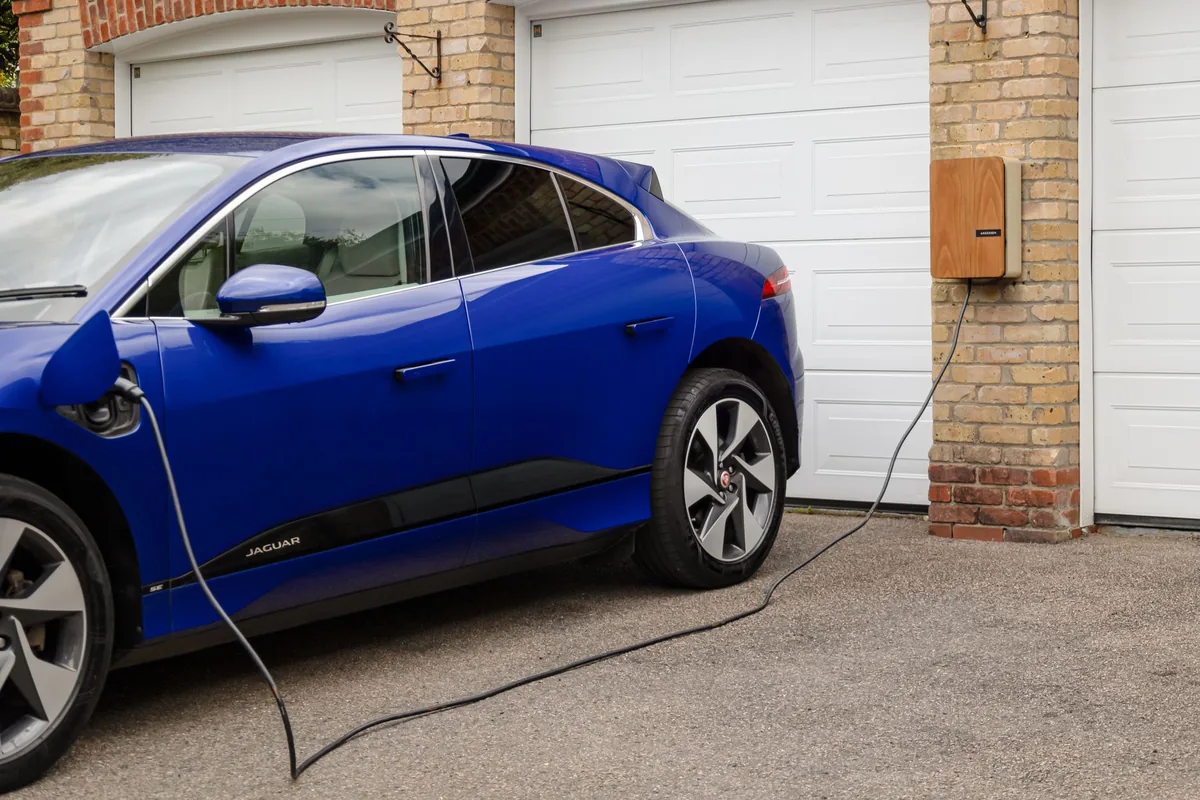
The cost to charge an electric car at home comes down to two numbers: how many kWh the car uses per 100 km, and what your household pays for a unit of electricity. Battery size, charger speed and badge matter far less. This guide works through both using 182 officially certified electric models and verified 2026 electricity prices across nine European markets plus the EU average.
We paired certified efficiency data with household rates from Eurostat and national regulators, then calculated a full year of home charging at 15,000 km. The result is a table you can read in ten seconds and a method you can re-run with your own mileage, tariff and car.
Public charging is the half of the picture where most published figures are guesswork. We hold no verified public rapid tariff, so we do not invent one. Instead we price public charging at 1.5x, 2x and 3x the home rate and label every multiple as an assumption.
Home charging cost at a glance
Household electricity in 2026 runs from €0.220/kWh on the EU average to €0.38/kWh in Ireland, with the UK at £0.263/kWh, Germany at €0.387/kWh and Finland at €0.225/kWh. The gap looks small per unit and is not small over a year, because a typical electric car draws more than two thousand kWh from the wall.
The table below assumes the median certified electric car, at 16.9 kWh/100km, driven 15,000 km. Every figure is kWh per 100 km divided by 100, multiplied by distance, multiplied by the market price.
| Market | Household rate | Annual kWh from the wall | Annual home charging cost | Per month |
|---|---|---|---|---|
| EU average | €0.220/kWh | 2,535 | €557.70 | €46.47 |
| Finland | €0.225/kWh | 2,535 | €570.37 | €47.53 |
| France | €0.256/kWh | 2,535 | €648.96 | €54.08 |
| Netherlands | €0.256/kWh | 2,535 | €648.96 | €54.08 |
| UK | £0.263/kWh | 2,535 | £666.70 | £55.56 |
| Spain | €0.267/kWh | 2,535 | €676.84 | €56.40 |
| Belgium | €0.35/kWh | 2,535 | €887.25 | €73.94 |
| Ireland | €0.38/kWh | 2,535 | €963.30 | €80.27 |
| Germany | €0.387/kWh | 2,535 | €981.04 | €81.75 |
| Sweden | 3.02 kr/kWh | 2,535 | 7,655.70 kr | 637.97 kr |
Household electricity: Eurostat nrg_pc_204 H2-2025 household band DC including taxes. Distance: 15,000 km for every market, so the only variable between rows is the price of a kWh.
How we calculate the cost to charge an electric car at home
The method is deliberately boring, because a boring method is one you can check. Annual energy is the certified consumption figure divided by 100, multiplied by distance. Annual cost is annual energy multiplied by the household price.
The data is the UK Vehicle Certification Agency's certified consumption for cars sold in Britain. We took all 182 electric rows and applied one quality rule: a certified figure outside 5.0 to 40.0 kWh/100km is not a real-world car and is excluded. We print exclusions rather than dropping them quietly. Here there was nothing to drop, so all 182 rows are in play and the exclusion count is zero.
Two of the three archives we hold are not used at all. The vca-mega and vca-archive datasets contain petrol, diesel, hybrid and plug-in hybrid records measured in litres per 100 km, with no electric rows carrying a kWh figure.
Working set: 182 certified electric rows, mean 17.46 kWh/100km, median 16.90, range 10.9 to 30.3 kWh/100km. Zero exclusions inside the 5.0 to 40.0 window.
Why certified kWh/100km drives the whole bill
Electric cars are sold on range, but range is a battery-size question. What sets your annual bill is efficiency: the electricity needed to move 100 km. A big battery in a thirsty car means you drive further between charges while paying more for every kilometre.
The certified figure is not a promise. It comes from a laboratory cycle with no passengers, no roof load and no air conditioning, and electric cars lose more than combustion cars in the cold, because energy goes into heating the pack and cabin instead of moving the car. It is still the only figure measured identically for every model.
Efficiency is therefore worth more than battery capacity. In the certified data the gap between a 13.3 and a 16.9 kWh/100km car is 27% on the same journey, and at €0.38/kWh that is real money every year.
The most efficient electric cars in the official data
The leaderboard is headed by the 2026 Mini Aceman at 10.9 kWh/100km — 1,635 kWh over 15,000 km — followed by the 2026 Mercedes-Benz CLA Saloon at 12.2 and the 2026 Dacia Spring at 12.5. Below that, a dense cluster of mainstream models sits between 13.3 and 14.9 kWh/100km, including the Fiat 500, Tesla Model 3, Tesla Model Y, Volkswagen ID.7, Hyundai Kona Electric and Peugeot 2008.
What stands out is how narrow the top of the table is. Eight of the twelve most efficient models sit within 1.5 kWh/100km of each other, so the annual cost difference between a Tesla Model 3 and a Hyundai Kona Electric is small enough to be swamped by insurance or depreciation.
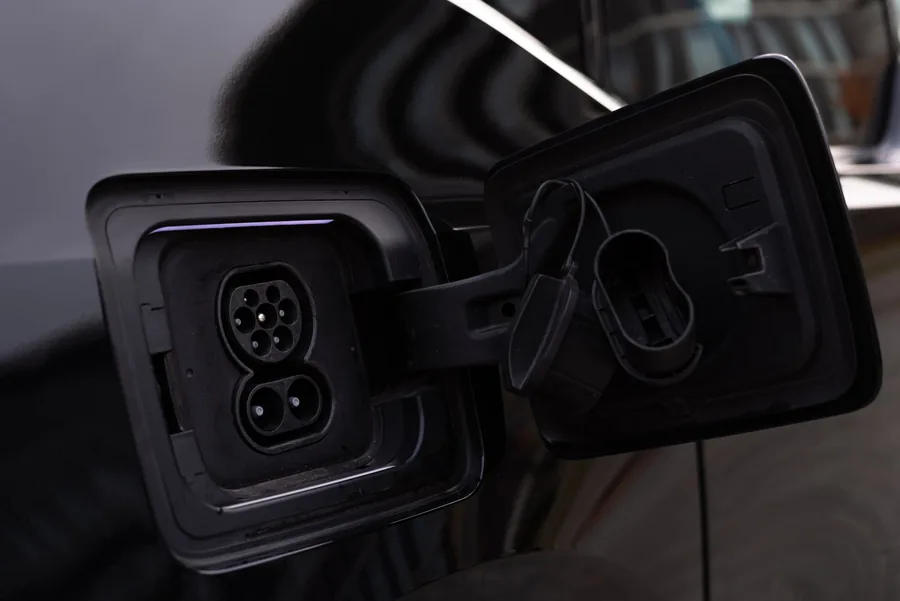
| Model | Year | kWh/100km | Annual kWh | €/yr at EU avg €0.220 | €/yr in Ireland €0.38 |
|---|---|---|---|---|---|
| Mini Aceman | 2026 | 10.9 | 1,635 | €359.70 | €621.30 |
| Mercedes-Benz CLA Saloon | 2026 | 12.2 | 1,830 | €402.60 | €695.40 |
| Dacia Spring | 2026 | 12.5 | 1,875 | €412.50 | €712.50 |
| Fiat 500 | 2025 | 13.3 | 1,995 | €438.90 | €758.10 |
| Tesla Model 3 | 2026 | 13.8 | 2,070 | €455.40 | €786.60 |
| Mini Cooper Electric | 2026 | 14.2 | 2,130 | €468.60 | €809.40 |
| Peugeot 2008 | 2026 | 14.2 | 2,130 | €468.60 | €809.40 |
| Tesla Model Y | 2026 | 14.2 | 2,130 | €468.60 | €809.40 |
| Volkswagen ID.7 | 2026 | 14.2 | 2,130 | €468.60 | €809.40 |
| Hyundai Kona Electric | 2023 | 14.3 | 2,145 | €471.90 | €815.10 |
| Volkswagen ID.7 Tourer | 2026 | 14.6 | 2,190 | €481.80 | €832.20 |
| Lexus RZ 350e | 2026 | 14.7 | 2,205 | €485.10 | €837.90 |
The thirstiest EVs and the 2.78x spread
The other end of the data shows what a heavy electric car costs to charge. A 2026 Mercedes-Benz G-Class G 580 is certified at 30.3 kWh/100km — 4,545 kWh over 15,000 km, nearly three times the energy the Mini Aceman needs over the same distance. Between the two the ratio is 2.78x.
In Ireland that spread is €1,105.80 a year: €621.30 against €1,727.10. In Finland, where power is cheaper, the same spread is €654.75.
The pattern in the thirstiest list is volume and weight. Large electric SUVs, vans and MPVs dominate: the Peugeot e-Traveller at 28.2 kWh/100km, the Toyota Proace Verso EV at 25.1, the Lotus Eletre at 24.1 and the Kia EV9 at 22.8.
| Model | Year | kWh/100km | Annual kWh | €/yr at EU avg €0.220 | €/yr in Ireland €0.38 |
|---|---|---|---|---|---|
| Mercedes-Benz G-Class G 580 | 2026 | 30.3 | 4,545 | €999.90 | €1,727.10 |
| Mercedes-Benz G-Class G 580 | 2027 | 30.0 | 4,500 | €990.00 | €1,710.00 |
| Peugeot e-Traveller | 2026 | 28.2 | 4,230 | €930.60 | €1,607.40 |
| Toyota Proace Verso EV | 2024 | 25.1 | 3,765 | €828.30 | €1,430.70 |
| Lotus Eletre | 2026 | 24.1 | 3,615 | €795.30 | €1,373.70 |
| Mercedes-Benz EQS SUV | 2026 | 22.9 | 3,435 | €755.70 | €1,305.30 |
| Kia EV9 | 2025 | 22.8 | 3,420 | €752.40 | €1,299.60 |
| Peugeot e-Rifter | 2026 | 22.7 | 3,405 | €749.10 | €1,293.90 |
Annual home charging cost per market for a typical electric car
The representative car here is the one sitting on the median of the certified data: 16.9 kWh/100km. Drive it 15,000 km and it draws 2,535 kWh from the wall. Multiply by the local household rate and you have the annual bill.
That is €557.70 a year on the EU average, €648.96 in France and the Netherlands, £666.70 in the UK, €676.84 in Spain, €887.25 in Belgium, €963.30 in Ireland, €981.04 in Germany and 7,655.70 kr in Sweden. The most expensive market costs 76% more than the cheapest for identical driving in an identical car.
Efficiency is fixed at the factory; the price of a kWh is not. A driver in Finland with a relatively thirsty car can pay less per year than a driver in Germany with a very efficient one.
| Market | Rate | Most efficient EV (10.9) | Typical EV (16.9) | Thirstiest EV (30.3) | Spread |
|---|---|---|---|---|---|
| EU average | €0.220/kWh | €359.70 | €557.70 | €999.90 | €640.20 |
| Finland | €0.225/kWh | €367.88 | €570.37 | €1,022.62 | €654.75 |
| France | €0.256/kWh | €418.56 | €648.96 | €1,163.52 | €744.96 |
| Netherlands | €0.256/kWh | €418.56 | €648.96 | €1,163.52 | €744.96 |
| UK | £0.263/kWh | £430.00 | £666.70 | £1,195.34 | £765.33 |
| Spain | €0.267/kWh | €436.55 | €676.84 | €1,213.52 | €776.97 |
| Belgium | €0.35/kWh | €572.25 | €887.25 | €1,590.75 | €1,018.50 |
| Ireland | €0.38/kWh | €621.30 | €963.30 | €1,727.10 | €1,105.80 |
| Germany | €0.387/kWh | €632.75 | €981.04 | €1,758.91 | €1,126.17 |
| Sweden | 3.02 kr/kWh | 4,937.70 kr | 7,655.70 kr | 13,725.90 kr | 8,788.20 kr |
All rows use 15,000 km. The three efficiency columns are real certified models: the Mini Aceman (10.9), the certified median car (16.9) and the Mercedes-Benz G-Class G 580 (30.3).
Ireland is the most expensive place in the EU to charge at home
Eurostat puts Irish household electricity at €0.404/kWh for the second half of 2025, the highest in the European Union. Germany follows at €0.387/kWh, Sweden at €0.271/kWh and France at €0.256/kWh, against an EU average of €0.220/kWh. Our cost tables use the Irish dataset rate of €0.38/kWh, so the Irish row is if anything conservative.
The same car costs close to twice as much to charge at home as on the EU average. The upside is that Irish pump prices are also among Europe's highest, at €1.84/L for petrol and €1.92/L for diesel on the EU Oil Bulletin for the week of 31 August 2026, so the comparison still favours electric, by a narrower margin than in France or Finland.
Two Irish electricity figures are correct at the same time: €0.38/kWh in our verified market dataset, and €0.404/kWh as the Eurostat H2-2025 headline for Irish households. Both come from Eurostat nrg_pc_204.
What a full charge costs from a household socket
Per-year figures suit budgeting, but most people want the price of one charge. Take a 60 kWh battery, typical of a mid-size electric car, and assume it arrives empty.
At the EU average rate a full 60 kWh charge costs €13.20. In Finland it is €13.50, France and the Netherlands €15.36, Spain €16.02, Belgium €21.00, Ireland €22.80 at our dataset rate and €24.24 at the Eurostat headline rate, Germany €23.22, the UK £15.78 and Sweden 181.20 kr.
Real sessions cost slightly more, because a charger does not deliver every unit it draws from the meter. A representative allowance is around 12%, shown in the final column. The conclusion holds either way: a full charge at home costs less than a tank of petrol in every market we track.
| Market | Rate | 60 kWh at the meter | With ~12% losses |
|---|---|---|---|
| EU average | €0.220/kWh | €13.20 | €14.78 |
| Finland | €0.225/kWh | €13.50 | €15.12 |
| France | €0.256/kWh | €15.36 | €17.20 |
| Netherlands | €0.256/kWh | €15.36 | €17.20 |
| UK | £0.263/kWh | £15.78 | £17.67 |
| Spain | €0.267/kWh | €16.02 | €17.94 |
| Belgium | €0.35/kWh | €21.00 | €23.52 |
| Ireland | €0.38/kWh | €22.80 | €25.54 |
| Ireland (Eurostat €0.404) | €0.404/kWh | €24.24 | €27.15 |
| Germany | €0.387/kWh | €23.22 | €26.01 |
| Sweden | 3.02 kr/kWh | 181.20 kr | 202.94 kr |
The 12% conversion allowance is a representative midpoint, not a measured figure for any specific car or charger. Real losses vary by vehicle, charger, temperature and charging power.
Home versus public charging: what can and cannot be quantified
There is no single public charging price. Networks bill per kWh, per minute, per session or by subscription, and the rate varies by network, country, charger power and roaming arrangement. Any single figure presented as the price of public charging is wrong for most drivers, so we will not print one.
What we can do is bound it. Public charging always costs more than domestic electricity for the same kWh, because the price must cover the network's energy purchase, demand charges, hardware, site rent, payment processing and margin. The only defensible answer to how much more is a multiple of the home rate.
So the next section costs the same annual energy at 1.5x, 2x and 3x home, labelling each multiplier an assumption. Above 3x you are in the region where a public-only electric car can match a petrol car per kilometre.

Explicit assumption: the 1.5x, 2x and 3x multiples below are illustrative, not tariffs. No verified public charging price is used anywhere in this guide.
Sensitivity: home charging at 1.5x, 2x and 3x
This table costs the same 2,535 kWh at the domestic rate and at 1.5 times, twice and three times that rate. For a driver doing 10,000 km a year rather than 15,000, scale every figure by two thirds.
At 2x an Irish driver pays €1,926.60 for energy that costs €963.30 at home, an extra €963.30 a year. The extra is £666.70 in the UK, €981.04 in Germany, €676.84 in Spain and €557.70 on the EU average. Even at a conservative 1.5x the penalty runs to several hundred euro annually in every market we track.
The ratio between home and public charging therefore matters more than almost any other running-cost variable an owner controls, and it is the one most exposed to circumstance: off-street parking, workplace charging, and how much of your charging can happen at home.
| Market | Home (1x) | 1.5x assumed | 2x assumed | 3x assumed | Extra at 2x |
|---|---|---|---|---|---|
| EU average | €557.70 | €836.55 | €1,115.40 | €1,673.10 | €557.70 |
| Finland | €570.37 | €855.56 | €1,140.75 | €1,711.12 | €570.37 |
| France | €648.96 | €973.44 | €1,297.92 | €1,946.88 | €648.96 |
| Netherlands | €648.96 | €973.44 | €1,297.92 | €1,946.88 | €648.96 |
| UK | £666.70 | £1,000.06 | £1,333.41 | £2,000.11 | £666.70 |
| Spain | €676.84 | €1,015.27 | €1,353.69 | €2,030.53 | €676.84 |
| Belgium | €887.25 | €1,330.87 | €1,774.50 | €2,661.75 | €887.25 |
| Ireland | €963.30 | €1,444.95 | €1,926.60 | €2,889.90 | €963.30 |
| Germany | €981.04 | €1,471.57 | €1,962.09 | €2,943.13 | €981.04 |
| Sweden | 7,655.70 kr | 11,483.55 kr | 15,311.40 kr | 22,967.10 kr | 7,655.70 kr |
The five-year view at twice the home rate
A single year understates the decision. Over five years, charging the typical car entirely at an assumed 2x the home rate costs an extra €4,816.50 in Ireland, €4,905.22 in Germany, €4,436.25 in Belgium, €3,384.22 in Spain, £3,333.52 in the UK and €2,788.50 on the EU average.
Set that against the premium an electric car usually carries over an equivalent petrol model and the arithmetic turns uncomfortable for anyone without a home charger. The saving that makes an electric car pay is largely the gap between domestic and public electricity, multiplied by several years of driving.
The reverse is the strongest financial argument in this guide. With home charging, five years of driving cost €4,816.50 in Ireland or €2,788.50 on the EU average, before any off-peak discount that would widen the advantage further.
| Market | 5 years at home | 5 years at 2x assumed | Extra over five years |
|---|---|---|---|
| EU average | €2,788.50 | €5,577.00 | €2,788.50 |
| Finland | €2,851.87 | €5,703.75 | €2,851.87 |
| France | €3,244.80 | €6,489.60 | €3,244.80 |
| Netherlands | €3,244.80 | €6,489.60 | €3,244.80 |
| UK | £3,333.52 | £6,667.05 | £3,333.52 |
| Spain | €3,384.22 | €6,768.45 | €3,384.22 |
| Belgium | €4,436.25 | €8,872.50 | €4,436.25 |
| Ireland | €4,816.50 | €9,633.00 | €4,816.50 |
| Germany | €4,905.22 | €9,810.45 | €4,905.22 |
| Sweden | 38,278.50 kr | 76,557.00 kr | 38,278.50 kr |
Charger losses: what happens between the meter and the battery
Energy at your meter is not the same as energy in the battery. The onboard charger converts alternating current into the direct current the battery stores, and that conversion is not free.
The effect is that a session the arithmetic prices at 60 kWh may draw noticeably more from the grid. A representative allowance for home AC charging is around 12%, which is why a losses column sits beside the raw figures. In cold weather the shortfall grows, because energy is spent heating the pack to a temperature where it accepts charge efficiently.
Two consequences follow. Compare what you pay at the meter, not the battery's nominal capacity, because a public charger's quote covers its own losses and yours does not.
Off-peak and EV-specific tariffs
Most markets offer time-of-use electricity, cheaper overnight and dearer at the evening peak. Some suppliers go further with a dedicated electric vehicle tariff: an unusually cheap window in the small hours paired with a higher daytime rate. For a household that can move most charging into the cheap window, this is the largest single reduction available on the home bill.
We quote no discount percentage, because terms differ by supplier, country and year, and a figure lifted from one market would be wrong in another. The mechanism is simple: you are paid for flexibility. Using it needs a charger or car that can schedule charging, and a tariff that genuinely has a cheap window.
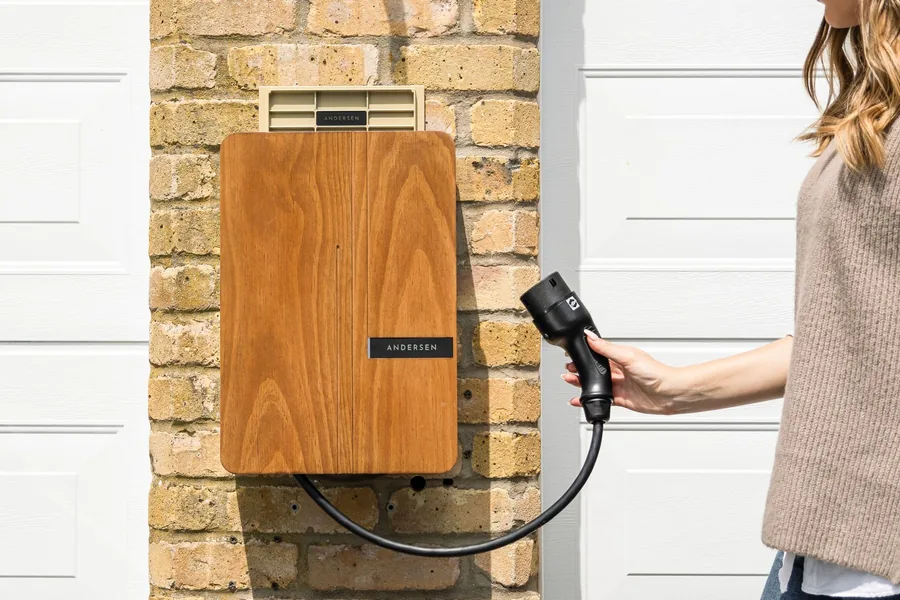
Savings, window length and eligibility vary by supplier and market, so no discount figure is quoted here. Check the current terms from your own electricity supplier.
Wallbox installation and the fixed cost of home charging
A dedicated home charger, usually 7 kW and sometimes 11 kW, turns a driveway into a fuel station. Hardware prices vary with the features you choose, such as load balancing and scheduled charging, and installation is priced on the wiring run, fuse-board capacity and local labour — we hold no verified price source for either, so we do not publish a figure. Some markets offer grants covering part of the cost, and the only honest number is the one on a quote for your own supply.
The economics are straightforward. Amortised over five years the hardware adds a small fixed amount per kWh delivered, while unlocking scheduled off-peak charging that a standard plug-in cable generally cannot. The payback is measured in months.
Charger power matters less than buyers expect. A 7 kW unit refills most cars overnight; 11 kW helps only if the car has a three-phase onboard charger able to accept it. If the car is limited to a lower AC input, paying for a faster wallbox buys nothing, so check the car's rating before buying.
Hardware and installation prices vary widely by market, charger specification and the electrical work required — we hold no verified source for a figure, so get a quote for your own supply.
Home charging versus filling a petrol car
Cost per 100 km is the cleanest comparison, because it removes annual mileage from the argument. In the same UK agency dataset, the average certified petrol car across 218 records uses 8.80 L/100km. At £1.64/L that is £14.43 per 100 km; at the EU average petrol price of €1.840/L from the EU Oil Bulletin, the same consumption costs €16.19.
The electricity equivalent for the typical electric car is €3.72 per 100 km on the EU average rate, €4.33 in France and the Netherlands, £4.44 in the UK, €4.51 in Spain, €6.42 in Ireland and €6.54 in Germany. Even in the most expensive market we track, home charging lands near 40% of EU-average petrol cost per distance driven.
What the comparison excludes matters as much as what it includes. Insurance, servicing, tyres, road tax and depreciation sit outside these figures on both sides. On energy alone, the case for charging at home is not close.
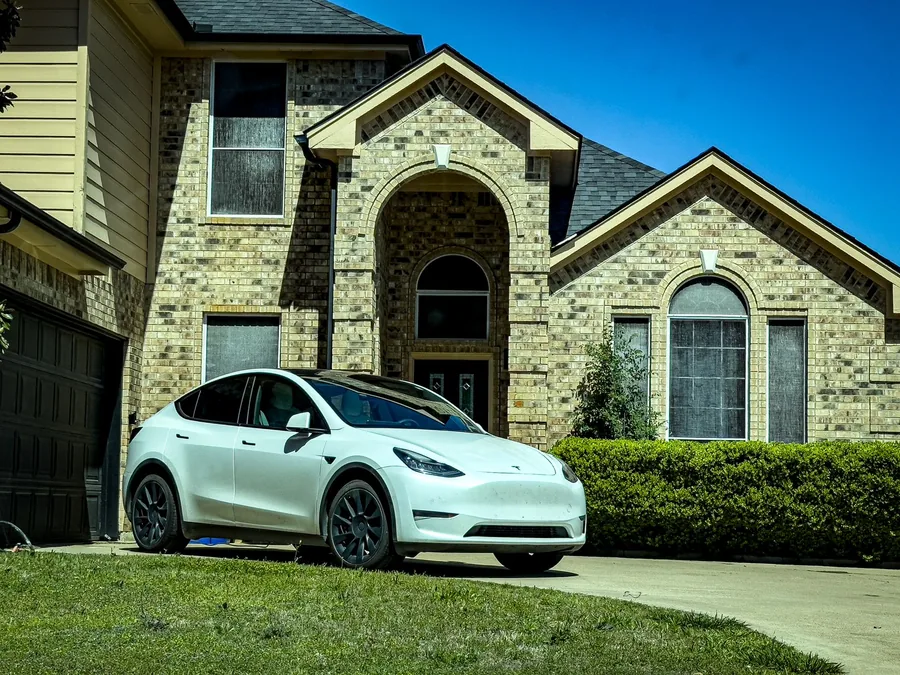
Petrol consumption: 8.80 L/100km, the mean of 218 certified petrol records in the current UK Vehicle Certification Agency dataset. Pump prices: EU Oil Bulletin, week of 31 August 2026.
When you cannot charge at home
A large share of European households have no off-street parking, and for them the arithmetic above is not directly available. The substitutes are workplace charging, kerbside AC, supermarket and destination chargers, and public rapid charging.
Workplace charging is usually the cheapest replacement, because many employers subsidise it or provide it at cost. Kerbside pricing varies enormously between councils and operators. Rapid DC charging is the most expensive option and, for a driver with no alternative, can push cost per kilometre close to a petrol car's.
So the financial case for an electric car rests on access to cheap electricity. Without it, the case must be made on lower servicing, quieter driving, purchase incentives or company-car tax treatment where that applies. Check your charging options before you sign, not after.
- Workplace charging is usually the cheapest substitute for a home charger.
- Kerbside AC rates vary by operator and council, so check your own street.
- Exclusive rapid DC charging is the worst case and can approach petrol cost per kilometre.
- Check charging at home, at work and at the places you visit weekly before buying.
Depreciation, insurance and the costs the tables leave out
Every figure in this guide is an energy cost. It excludes insurance, which varies with driver, location and vehicle group; servicing and repairs, which depend on age, mileage and labour rates; tyres, which wear faster on heavy electric cars; road tax; and depreciation.
Depreciation deserves the most attention, because for a new car it is usually the largest single cost of ownership. Typical market behaviour is a fall of roughly 15% to 25% in year one and about 50% over five years. On a €40,000 car that dwarfs the €2,788.50 it costs to charge the typical electric car at home for five years on the EU average rate.
The energy saving is real, but it is not the whole decision.
Depreciation figures are general market behaviour stated as approximate, not a prediction for any specific model.
Seven ways to cut your home charging bill
Since the two levers are efficiency and price per kWh, the actions split into changing the car or changing when and how you buy electricity. The second group is cheaper, faster and available today.
- Switch to a tariff with a cheap overnight window and move as much charging into it as possible.
- Set the car or charger to schedule charging instead of starting the moment you plug in.
- Check the car's onboard charger limit before paying for a faster wallbox.
- Compare kWh per 100 km, not battery size, when choosing between two electric models.
- Pre-condition the cabin and battery while still plugged in, so that energy is billed at home.
- Charge to what you need rather than to 100% nightly, which cuts losses and battery wear.
- If you have solar or a cheap daytime rate, check whether the charger can use it.
Key numbers at a glance
The median certified electric car in the official data uses 16.9 kWh/100km. Over 15,000 km it draws 2,535 kWh, costing €557.70 on the EU average rate, €648.96 in France and the Netherlands, £666.70 in the UK, €676.84 in Spain, €887.25 in Belgium, €963.30 in Ireland, €981.04 in Germany and 7,655.70 kr in Sweden.
The most efficient certified model is the 2026 Mini Aceman at 10.9 kWh/100km; the thirstiest is the 2026 Mercedes-Benz G-Class G 580 at 30.3, a spread of 2.78x on identical driving, worth €1,105.80 a year in Ireland and €640.20 on the EU average.
Home charging is the cheapest energy an electric car can use and public charging the most expensive. We can price the first exactly and the second only as a multiple, which is why this guide stops short of naming a public tariff.
Use the free calculators
Frequently asked questions
What does it cost to charge an electric car at home in 2026?
A typical certified electric car using 16.9 kWh/100km driven 15,000 km draws 2,535 kWh a year. At the EU average household rate of €0.220/kWh that costs €557.70, and at Ireland's €0.38/kWh it costs €963.30. Multiply your own consumption by distance and your local rate for a personal figure.
How much cheaper is home charging than public charging?
We cannot quote a verified public rapid tariff, so the honest answer is a multiple. Public charging must cover energy, demand charges, hardware, rent and margin on top of the domestic price, so it is always higher. We model 1.5x, 2x and 3x the home rate and label those as assumptions, not prices.
Which country has the cheapest electricity for EV charging?
Of the markets we track, Finland is cheapest at €0.225/kWh, followed by France and the Netherlands at €0.256/kWh. Sweden works out cheapest of all at 3.02 kr/kWh, against an EU average of €0.220/kWh. Ireland is highest at €0.404/kWh on Eurostat H2-2025 data, with Germany at €0.387/kWh.
How much does a car's efficiency affect the annual bill?
More than most buyers expect. The best certified model in the official data uses 10.9 kWh/100km and the thirstiest 30.3, a ratio of 2.78x. In Ireland that is the difference between €621.30 and €1,727.10 a year for identical mileage, so comparing kWh/100km is worth more than comparing battery sizes.
What time of day is cheapest for charging at home?
Overnight, on a time-of-use or EV-specific tariff with a cheap night window. The size of the saving and the length of the window differ by supplier and market, so we do not quote a discount percentage. You need a charger or car that can schedule a charge to make use of it.
Is a wallbox worth installing?
For anyone with off-street parking, usually yes. Hardware and installation prices vary with the unit and the wiring required, so the only figure that means anything is a quote for your own supply. A wallbox enables scheduled off-peak charging, which a standard plug-in cable generally cannot, and it makes the domestic-versus-public saving available every night.