Cheapest cars to run in France in 2026: a full coût d'entretien comparison

The voiture la moins chère à entretenir in France in 2026 is not the one with the lowest price on the forecourt — it is the car that burns the least fuel or electricity over the kilometres you actually drive. This coût d'entretien comparison ranks every model in the official type-approval data by what it costs to move at today's French energy prices.
We analysed 17,270 official records, cleaned them down to 16,728 usable entries, and priced each one at the verified French constants of €2.073 per litre petrol, €2.209 per litre diesel and €0.256 per kWh household electricity, over 15,000 km a year. The result is a pure efficiency index: petrol, diesel, hybrid and electric models ranked side by side, with a separate look at what the one-off carte grise and the malus 2026 mean for the first year of ownership in France.
How the 2026 France cheapest-to-run ranking was built
Every figure on this page comes from the type-approval records we hold for the French market: three datasets with 17,270 rows between them, covering petrol, diesel, hybrid and electric models from roughly model year 2000 to 2027. Records are filtered by a plausibility window — 2.5 to 25.0 litres per 100 km for combustion cars and 5.0 to 40.0 kWh per 100 km for electric cars — and then de-duplicated to one entry per make, model, year and powertrain. That leaves 16,728 usable rows and 14,919 distinct make-model-year-fuel combinations.
Annual cost is calculated directly from the certified figure: litres (or kWh) per 100 km, divided by 100, multiplied by 15,000 km, multiplied by the French unit price. The constants are the verified French defaults used throughout our calculators: petrol €2.073 per litre and diesel €2.209 from the EU Oil Bulletin, household electricity €0.256 per kWh from Eurostat, and 15,000 km a year. Using one fixed mileage and one price set for every car means the ranking reflects only the vehicle's own certified efficiency.
Every euro total on this page is energy cost only. France has no annual road tax for private cars, and the contrôle technique (~€78) is quoted separately for context and is never added into the table figures.
Data quality disclosure: three implausible rows, 537 plug-in hybrids and two mis-tags
Before publishing any ranking we clean the source data and say exactly what we removed. Three rows were dropped as implausible source artefacts: a 2026 Toyota Land Cruiser hybrid at 26.2 L/100km, a 2007 Kia Sorento diesel at 35.8 L/100km and a 2022 Mazda CX-60 petrol at 141.2 L/100km. These values are either data-entry errors or test-cycle artefacts that no driver could reproduce. A further two rows tagged as ordinary hybrids — a Land Rover Range Rover and a Range Rover Sport, both 18MY, both listed at 2.8 L/100km — are plug-in figures mislabelled in the source and are excluded from the hybrid table.
The remaining 537 removed rows are plug-in hybrids. Their official numbers are not a single consistent driving mode, because the test assumes a charged battery for part of every trip; we publish no plug-in leaderboard rather than a figure you cannot reproduce. After all exclusions the clean pool is 16,728 rows, split into 8,248 petrol, 6,046 diesel, 443 non-plug hybrid and 182 electric records.
Average running cost by fuel type in France
Across the clean pool the average petrol car consumes 8.6 L/100km and emits 201 g/km CO₂ — about €2,668 a year in fuel at €2.073 a litre over 15,000 km. The average diesel is far more frugal on paper at 5.9 L/100km and 155 g/km, or €1,945 a year. The average non-plug hybrid sits at 6.1 L/100km and 139 g/km, or €1,907, and the average electric car uses 17.5 kWh/100km, or €670 a year on household electricity.
Two patterns stand out in the French data. Electricity is so much cheaper per unit of energy than petrol that the electric average undercuts even the best diesel average, despite an EV pool full of large, heavy cars. And the hybrid average is higher than the diesel average, which surprises drivers who assume hybrid always means lowest fuel use — the hybrid pool here is dominated by bigger family cars, while the diesel pool is mostly small hatchbacks.
| Powertrain | Records | Average consumption | Average CO₂ | Average annual energy cost |
|---|---|---|---|---|
| Petrol | 8,248 | 8.6 L/100km | 201 g/km | €2,668 |
| Diesel | 6,046 | 5.9 L/100km | 155 g/km | €1,945 |
| Hybrid (non-plug) | 443 | 6.1 L/100km | 139 g/km | €1,907 |
| Electric | 182 | 17.5 kWh/100km | not recorded in source | €670 |
Cheapest petrol cars to run in France
The petrol table is led by the Honda Insight at 3.4 L/100km and €1,057 a year — an early two-seat design type-approved as a petrol car. Behind it sits the Suzuki Celerio at 3.6 L/100km and €1,119, the lowest figure of any current small hatchback. A tight cluster then follows at 3.8 L/100km and €1,182: the Citroën C1, the Fiat 500 and 500C, the Peugeot 108 and the petrol-tagged Kia Niro. A fourth group at 4.0 to 4.1 L/100km and €1,244 to €1,275 adds the Hyundai i10, Smart fortwo coupé, Peugeot 308, Volkswagen Polo and Nissan Micra.
The spread inside the table is under €220 a year between the best current car and the tenth-placed model, but against the market average it is enormous. The cheapest practical petrol car costs €1,119 to move; the average petrol car costs €2,668. Choosing from the top of this list instead of the middle of the market is worth roughly €1,549 a year, every year. Every model here is a small city car — larger petrol cars do not appear until consumption climbs past 5 L/100km.
| Make | Model | Year | Consumption | CO₂ | Annual energy cost |
|---|---|---|---|---|---|
| Honda | Insight | 2000 | 3.4 L/100km | 80 g/km | €1,057 |
| Suzuki | Celerio | 2017 | 3.6 L/100km | 84 g/km | €1,119 |
| Citroën | C1 | 2016 | 3.8 L/100km | 88 g/km | €1,182 |
| Fiat | 500 & 500C | 2018 | 3.8 L/100km | 90 g/km | €1,182 |
| Peugeot | 108 | 2014 | 3.8 L/100km | 88 g/km | €1,182 |
| Kia | Niro | 2018 | 3.8 L/100km | 88 g/km | €1,182 |
| Hyundai | i10 | 2017 | 4.0 L/100km | 93 g/km | €1,244 |
| Smart | fortwo coupé | 2016 | 4.0 L/100km | 98 g/km | €1,244 |
| Peugeot | 308 | 2017 | 4.0 L/100km | 95 g/km | €1,244 |
| Volkswagen | Polo | 2016 | 4.1 L/100km | 94 g/km | €1,275 |
| Nissan | Micra | 2013 | 4.1 L/100km | 95 g/km | €1,275 |
Cheapest diesel cars to run in France
The diesel table is led by the 2017 Peugeot 208 at 3.0 L/100km and €994 a year — the cheapest combustion car of any kind in the French dataset. The Peugeot 308 follows at 3.1 L/100km and €1,027, then a dense block at 3.2 L/100km and €1,060 that includes the Ford Fiesta, Nissan Micra, Škoda Octavia, Hyundai i20, Volkswagen Golf, Kia Rio and Renault Clio. Diesel engines still convert fuel more efficiently than petrol, and the certified figures reflect that: the best diesel undercuts the best mainstream petrol by a clear margin.
The catch for French buyers in 2026 is that the pump has turned against diesel. French diesel now costs €2.209 a litre against €2.073 for petrol, so the diesel car has to overcome a €0.136 per litre handicap before its efficiency advantage pays off. Even so, the roughly 30% efficiency edge on litres burned still wins overall: the average diesel saves about €723 a year over the average petrol at 15,000 km, and the cheapest diesel saves about €951 against the average diesel. Whether that survives the higher purchase price of a diesel variant is the real question for a buyer.
| Make | Model | Year | Consumption | CO₂ | Annual energy cost |
|---|---|---|---|---|---|
| Peugeot | 208 | 2017 | 3.0 L/100km | 79 g/km | €994 |
| Peugeot | 308 | 2017 | 3.1 L/100km | 82 g/km | €1,027 |
| Ford | Fiesta | 2017 | 3.2 L/100km | 82 g/km | €1,060 |
| Nissan | Micra | 2018 | 3.2 L/100km | 85 g/km | €1,060 |
| Škoda | Octavia | 2014 | 3.2 L/100km | 85 g/km | €1,060 |
| Hyundai | i20 | 2016 | 3.2 L/100km | 84 g/km | €1,060 |
| Volkswagen | Golf | 2014 | 3.2 L/100km | 85 g/km | €1,060 |
| Kia | Rio | 2011 | 3.2 L/100km | 85 g/km | €1,060 |
| Renault | Clio | 2014 | 3.2 L/100km | 83 g/km | €1,060 |
Cheapest non-plug hybrids in France
With the two mis-tagged Range Rover plug-in rows removed, the hybrid table is led by the 2018 Toyota Prius at 3.0 L/100km and €933 a year — the cheapest combustion car in the whole French dataset apart from the diesels. The Yaris follows at 3.3 L/100km and €1,026, then the Hyundai Ioniq at 3.4 L/100km and €1,057, the Toyota Auris at 3.5 L/100km and €1,088, the Lexus CT at 3.6 L/100km and €1,119, and the Kia Niro at 3.7 to 3.8 L/100km. Two current-model arrivals, the Mazda2 Hybrid and the Toyota Aygo X HEV, both land at 3.8 L/100km and €1,182.
Toyota appears five times in this list, which reflects a hybrid system tuned for exactly the stop-start cycles the official test measures. These are self-charging hybrids — no plug, no claimed electric range — so the numbers are reproducible in daily driving without a charger. The hybrid advantage comes from regenerative braking and engine-off coasting in town; on a steady motorway cruise the battery cannot recharge from braking and the gap to a good diesel narrows. For drivers with no home charging, often in flats and city apartments, a self-charging hybrid is the practical low-cost option.
| Make | Model | Year | Consumption | CO₂ | Annual energy cost |
|---|---|---|---|---|---|
| Toyota | Prius | 2018 | 3.0 L/100km | 70 g/km | €933 |
| Toyota | Yaris | 2018 | 3.3 L/100km | 75 g/km | €1,026 |
| Hyundai | Ioniq | 2017 | 3.4 L/100km | 79 g/km | €1,057 |
| Toyota | Auris | 2018 | 3.5 L/100km | 79 g/km | €1,088 |
| Lexus | CT | 2014 | 3.6 L/100km | 82 g/km | €1,119 |
| Kia | Niro | 2018 | 3.7 L/100km | 86 g/km | €1,151 |
| Mazda | Mazda2 Hybrid | 2026 | 3.8 L/100km | 87 g/km | €1,182 |
| Toyota | C-HR | 2018 | 3.8 L/100km | 86 g/km | €1,182 |
| Toyota | Aygo X HEV | 2026 | 3.8 L/100km | 87 g/km | €1,182 |
Why official plug-in hybrid figures cannot be trusted
Plug-in hybrids are tested with a full battery and the engine switched off for as much of the cycle as possible. The resulting combined figure — often 1 to 2 L/100km — assumes you recharge before every journey and never drive further than the electric range. In reality most plug-in owners charge irregularly, drive longer trips on the engine alone, and carry the weight of a battery and motor the engine must haul once the charge is gone. The two Range Rover rows tagged as hybrids at 2.8 L/100km are exactly this problem: an official plug-in test result, not a number you will see on a motorway run.
The test weights electric and engine operation by a theoretical daily pattern, assuming a large share of kilometres are driven on grid electricity. Fleet data shows the real electric share is often well below that. Once the battery is flat a plug-in becomes a heavy petrol car with a small engine, and consumption can climb above 8 L/100km. That is why we publish no plug-in leaderboard: a figure that depends on a charging habit you may not have is not a running cost, it is a best case. If you can charge daily and rarely exceed the electric range, a plug-in can beat the non-plug hybrids — otherwise treat the official number as a laboratory bound.
Cheapest electric cars to run in France
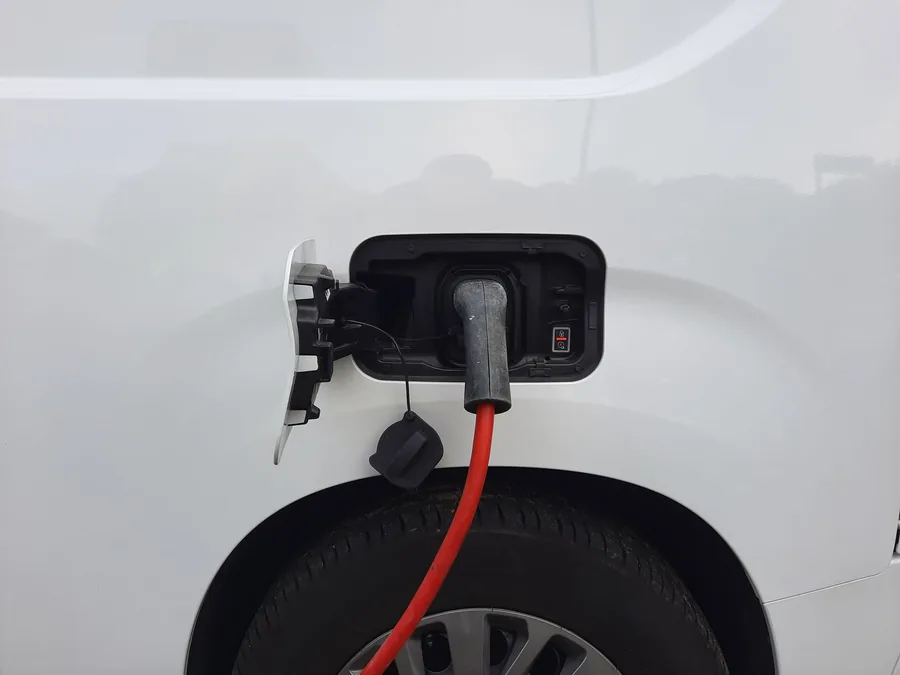
The electric table is led by the 2026 Mini Aceman at 10.9 kWh/100km and €419 a year — less than half the cheapest petrol Celerio. The Mercedes-Benz CLA Saloon follows at 12.2 kWh/100km and €468, then the Dacia Spring at 12.5 kWh/100km and €480, the Fiat 500 at €511, and a broad group at 14.2 kWh/100km and €545 that includes the Tesla Model 3 and Model Y, the Mini Cooper Electric, the Peugeot 2008 and the Volkswagen ID.7. French household electricity at €0.256 a kWh is among the cheapest in the EU, and electric motors convert over 90% of that energy into motion against roughly 30% for a petrol engine.
The EV table spans a much narrower range than the petrol table, so EV choice can be driven by space, range and equipment rather than running cost. The Dacia Spring is the cheapest EV to buy in France and among the cheapest to run. The Tesla Model 3 and Model Y appear because efficient thermal management and low-drag shapes keep their consumption low despite their size. Note that these figures use home electricity at €0.256 a kWh; public rapid charging costs more, so a driver without home charging will not see the full saving.
| Make | Model | Year | Consumption | Annual energy cost |
|---|---|---|---|---|
| Mini | Aceman | 2026 | 10.9 kWh/100km | €419 |
| Mercedes-Benz | CLA Saloon | 2026 | 12.2 kWh/100km | €468 |
| Dacia | Spring | 2026 | 12.5 kWh/100km | €480 |
| Fiat | 500 | 2025 | 13.3 kWh/100km | €511 |
| Tesla | Model 3 | 2026 | 13.8 kWh/100km | €530 |
| Mini | Cooper Electric | 2026 | 14.2 kWh/100km | €545 |
| Peugeot | 2008 | 2026 | 14.2 kWh/100km | €545 |
| Tesla | Model Y | 2026 | 14.2 kWh/100km | €545 |
| Volkswagen | ID.7 | 2026 | 14.2 kWh/100km | €545 |
No annual road tax in France: what it means for running costs
France is unusual among the markets we cover in that private cars pay no annual road tax at all. There is no yearly circulation tax to add, no CO₂-band renewals, and no equivalent of the UK's VED or the Netherlands' MRB. The tax burden on a French car is concentrated at the two ends of ownership: a one-off registration cost when you first put the car on the road, and fuel duty that is already baked into the pump prices used on this page.
Registration is where the one-off carte grise fee applies, and for higher-emission cars the malus écologique adds a sliding penalty based on certified CO₂. Because the malus scales with emissions, a low-CO₂ petrol, hybrid or electric model keeps that registration hit small, while a big-engined, high-CO₂ car pays a large one — which is one more reason the efficiency tables here matter for a French buyer's first-year cash outlay. We do not quote carte grise or malus figures because they change by region, car and year, but the direction is fixed: the greener the car, the lighter the one-off tax. On top of registration, the contrôle technique roadworthiness test costs around €78 on its fixed cycle.
- Annual road tax: none for private cars in France
- Registration: a one-off carte grise fee, plus the malus écologique for high-CO₂ cars
- Roadworthiness test: contrôle technique, ~€78, on a fixed cycle
- None of these are included in the energy totals on this page
Coût d'entretien: the same car at 10,000, 15,000 and 20,000 km
Annual mileage changes the whole comparison, and because the cost formula is linear in distance you can scale any figure on this page to your own driving. The table below shows what an average car of each powertrain costs to run at 10,000, 15,000 and 20,000 km a year, holding French energy prices fixed. A low-mileage driver who covers 10,000 km cuts the average petrol bill by a third; a high-mileage driver at 20,000 km adds a third.
The ordering never changes with distance, only the size of the gaps. Electric is cheapest at every mileage, diesel next, then hybrid, then petrol, because these are all functions of the same certified efficiencies and the same price ratio between electricity and fuel. What changes is the absolute stake: at 10,000 km the petrol-versus-electric gap is about €1,332 a year, and at 20,000 km it is about €2,664.
| Powertrain | 10,000 km | 15,000 km | 20,000 km |
|---|---|---|---|
| Petrol (avg) | €1,779 | €2,668 | €3,557 |
| Diesel (avg) | €1,297 | €1,945 | €2,593 |
| Hybrid (avg) | €1,271 | €1,907 | €2,543 |
| Electric (avg) | €447 | €670 | €893 |
The spread between the cheapest and thirstiest petrol car in France
At the other end of the table sit the thirsty cars. The 2000 Lamborghini Diablo consumes 24.9 L/100km — about €7,743 a year at French prices, with the McLaren GT close behind at 23.7 L/100km and €7,370 a year. Against the cheapest petrol city car at €1,119, that is a spread of roughly €6,624 a year between two legal, road-going cars. Put another way, the fuel bill of one Diablo is about the same as running seven Suzuki Celerios.
That gap is more than nine times the entire annual energy cost of the cheapest electric car on this page. It is the clearest illustration of why running cost, not purchase price, decides how cheap a car really is: two vehicles can differ by more than €6,600 a year in what they burn, and no sticker price reflects that. These are certified values for cars that were sold in France, not outliers invented to make a point.
Why diesel is now dearer than petrol in France in 2026
For decades diesel was cheaper at the pump than petrol across most of Europe, which reinforced the case for diesel cars. In France in 2026 that has flipped: petrol is €2.073 a litre and diesel €2.209, so diesel now carries a €0.136 per litre penalty. The old pump-price bonus is not just gone, it has reversed, and every diesel litre costs more than a petrol litre before the engine's efficiency is even counted.
The diesel car still wins overall because it burns far fewer litres — the average diesel uses 5.9 L/100km against 8.6 L/100km for the average petrol, which is a large gap over a year of driving. At 15,000 km the average diesel saves about €723 a year over the average petrol; at 10,000 km that falls to roughly €482. Buyers who cover fewer kilometres may never recover the extra cost of a diesel variant, while high-mileage drivers still get a clear yearly saving. The higher purchase price of diesel models and the malus applied to higher-CO₂ cars trim the advantage further.
What the consumption figures do not include
The tables show only the energy cost of moving the car — fuel or electricity at the stated prices. They do not include insurance, which varies by driver, region and car group; servicing and repairs, which depend on age and mileage; depreciation, which is roughly 15 to 25% in year one and about 50% over five years for a typical new car; the one-off carte grise and malus; the contrôle technique beyond the €78 reference; or public charging prices for EVs, which are typically higher than the household rate. For a full cost of ownership, use the car cost calculator with your own insurance quote, mileage and ownership period.
How to use these numbers to choose a car
Start with your annual mileage. At 15,000 km the gaps shown are accurate; at 10,000 km reduce them by a third, at 20,000 km add a third. Next, match the powertrain to how you actually drive: short city trips favour non-plug hybrids and small petrol cars, steady motorway miles favour efficient diesels and long-range EVs, and anyone with home charging should look hard at the cheapest electric models. Then add the fixed costs — your model's one-off registration tax, the contrôle technique and insurance — because a difference in insurance can outweigh a fuel saving. Finally, get quotes for your shortlist before deciding.
- City and short trips → non-plug hybrid or small petrol
- Motorway miles → efficient diesel or long-range EV
- Home charging available → cheapest electric models
- High-CO₂ car → check the malus before you buy, it can be large
The limits of official test figures
WLTP and NEDC are laboratory cycles run on a rolling road at controlled temperature with no passengers, no roof load and no air conditioning. Real-world consumption is typically 10 to 25% higher for petrol and diesel, 15 to 30% higher for EVs in winter, and far higher for plug-ins driven beyond their electric range. The figures here are the only consistent, legally mandated basis for comparing models, but they are not a promise of what you will spend. Treat them as a ranked index: if one car tests at 4.0 L/100km and another at 6.0 L/100km, the first will almost always cost less to run in the same hands.
Who this data suits and who it does not
This ranking is built for private buyers and fleet managers who want a fuel-cost baseline before layering on insurance, finance, maintenance and depreciation. It is less useful for company-car calculations, which use a different CO₂ methodology; for drivers who rely on public rapid charging, where electricity costs more than the household rate; for buyers comparing used cars with unknown service history; or for anyone whose mileage is far from 15,000 — the ordering stays the same but the absolute numbers scale with distance. For those cases, enter your own mileage and energy prices into the calculators linked below.
Key comparisons at a glance
Four headline comparisons hold across the dataset. Cheapest petrol city car (Suzuki Celerio, €1,119) against the French petrol average (€2,668) saves about €1,549 a year. Cheapest diesel (Peugeot 208, €994) against the diesel average (€1,945) saves about €951. Average diesel (€1,945) against average petrol (€2,668) saves about €723. And average electric (€670) against average petrol (€2,668) saves about €1,998 — more than any combustion option can match. These gaps come from energy price and efficiency, not from tax breaks, so they persist as long as the ratio between the pump and the socket holds.
Depreciation context for the cheapest-to-run models
Depreciation is the largest single cost for most owners and it is not captured in the fuel tables, because it depends on model, age, mileage and market. As a rough guide, a typical new car loses 15 to 25% of its value in year one and about 50% over five years. Small city cars like the Celerio, i10, Aygo and Micra tend to depreciate faster in percentage terms because they start from a low price, but the cash loss is smaller. Hybrids and efficient diesels often hold value well on strong used demand, while EV depreciation varies with battery technology and brand. Always model depreciation for your specific shortlist with the depreciation calculator before deciding.
Use the free calculators
Frequently asked questions
What is the cheapest car to run in France in 2026?
On pure energy cost the cheapest car in our French dataset is the 2026 Mini Aceman electric at €419 a year, using 10.9 kWh/100km at €0.256 per kWh. Among combustion cars the 2018 Toyota Prius hybrid and the 2017 Peugeot 208 diesel lead, both under €1,000 a year at 15,000 km.
How much does the average car cost to run in France per year?
Across 8,248 petrol records the average French petrol car uses 8.6 L/100km, about €2,668 a year in fuel at €2.073 a litre over 15,000 km. The average diesel is €1,945, the average non-plug hybrid €1,907 and the average electric car €670 a year on household electricity.
Is there annual road tax in France in 2026?
No. Private cars in France pay no annual road tax, so there is no yearly circulation charge to add to your running costs. The tax sits at registration instead: a one-off carte grise fee, plus the malus écologique for high-CO₂ cars. None of these are included in the fuel totals on this page.
What is the malus 2026 and does it affect running costs?
The malus écologique is a one-off registration penalty based on a car's certified CO₂ emissions, charged when the car is first put on the road in France. It is not an annual running cost, but it raises the first-year outlay significantly for high-emission cars and not at all for very low-emission petrol, hybrid and electric models. We do not quote exact figures because they change by year and car.
Is a diesel or a petrol car cheaper to run in France?
Diesel still wins on fuel because the average diesel uses 5.9 L/100km against 8.6 L/100km for petrol, saving about €723 a year on average at 15,000 km. But in 2026 French diesel costs more per litre than petrol (€2.209 versus €2.073), so the saving comes purely from efficiency, not from a cheaper pump price.
Are plug-in hybrids cheaper to run than normal hybrids?
Only if you charge daily and rarely exceed the electric range. Official plug-in figures (often 1 to 2 L/100km) assume a full battery every trip, and real fuel use jumps once the battery is empty. We exclude plug-in hybrids from the hybrid leaderboard because the test figure is not a single consistent driving mode.
Do these running costs include insurance, servicing and depreciation?
No. The tables show energy cost only — fuel or electricity at the stated French prices. Insurance, servicing, repairs, the one-off carte grise and malus, the contrôle technique beyond the €78 reference, depreciation and public charging are excluded. Use the car cost calculator to add those for a full ownership total.