What Tyres Really Cost in 2026: Priced by Size, Not Guesswork
Tyre price is the one car cost that changes more by size than by anything else, and almost nobody quotes it that way. Ask what four new tyres cost and you get a shrug, a memory of a number from three years ago, or a price for a different car. So we priced it properly: 240 individual fitted listings, pulled on 24 October 2026, across ten sizes, from a small hatchback's 175/65 R14 up to a large saloon's 245/40 R19, from a UK online retailer with a partner fitting network. Every price on this page is a real listing from that day, not a survey average or a memory.
The result is less dramatic and more useful than the scare stories. A set of four tyres for a small car starts at 183.96 pounds fitted. The same exercise on a large 19-inch wheel starts at 310.40 pounds and goes to 903.96 pounds if you buy the dearest tyre on the page. That is a 4.9-fold difference in what is, at the end of the day, four rings of rubber. Below you get the size-by-size table, what the extra money actually buys on the EU tyre label, how long a set really has to last for the maths to work, and the honest gaps: which numbers we could verify and which we could not. Where a figure is missing, we say so rather than filling it in.
How much does a set of four tyres cost in 2026?
Here is the whole answer in one table. The cheapest column is the lowest per-tyre price we found on any listing in that size on 24 October 2026, multiplied by four. The median is the middle price of the 24 listings in that size, so it reflects what a typical tyre in that size costs rather than the cheapest bargain or the dearest flagship. The dearest column is the top of the observed range.
Two things jump out of it. The first is the size ladder: a 175/65 R14 set starts at 183.96 pounds, a 205/55 R16 set at 199.96 pounds, and a 235/60 R18 set at 319.96 pounds. The second is the spread inside a single size. In 205/55 R16, the most common size in Europe, the per-tyre price on that day ran from 49.99 pounds to 108.99 pounds, which is 2.2 times the cheapest for a tyre that fits the same wheel.
| Tyre size | Listings | Cheapest set of 4 | Median set of 4 | Dearest set of 4 |
|---|---|---|---|---|
| 175/65 R14 | 24 | £183.96 | £259.96 | £423.96 |
| 185/65 R15 | 24 | £195.96 | £279.96 | £499.96 |
| 195/65 R15 | 24 | £195.96 | £299.18 | £442.88 |
| 205/55 R16 | 24 | £199.96 | £369.96 | £435.96 |
| 215/55 R17 | 24 | £235.96 | £511.96 | £699.96 |
| 225/45 R17 | 24 | £235.96 | £393.96 | £487.96 |
| 225/40 R18 | 24 | £231.96 | £423.96 | £499.96 |
| 235/55 R18 | 24 | £313.68 | £603.96 | £739.96 |
| 235/60 R18 | 24 | £319.96 | £553.96 | £739.96 |
| 245/40 R19 | 24 | £310.40 | £697.96 | £903.96 |
Why the number on your sidewall decides the price
A tyre size like 205/55 R16 is not a brand or a quality grade. It is a physical measurement: 205 millimetres of tread width, a sidewall height equal to 55 per cent of that width, and a 16-inch hole in the middle for the wheel. Change any of those numbers and you need a different tyre, which is why the price you paid for your last car tells you nothing about the price for this one.
The pattern in our data is that price climbs with the diameter, but not smoothly. A 15-inch set starts under 200 pounds. A 17-inch set starts at 235.96 pounds. An 18-inch set starts somewhere between 231.96 and 319.96 pounds depending on the width and profile, and a 19-inch set starts at 310.40 pounds. The jump between 17 and 18 inches is small on the cheapest tyres and large on the typical ones: the median 215/55 R17 set is 511.96 pounds while the median 225/40 R18 set is 423.96 pounds. Low-profile tyres on wide rims are not automatically dearer at the bottom of the market, but they are far dearer in the middle of it, because that is where the volume brands sit.
The practical consequence is that the size fitted to a car at the factory follows that car for its whole life. If you are choosing between two used cars and one needs 19-inch rubber, the tyre bill alone is a running cost difference of hundreds of pounds per set, and that belongs in the comparison before you look at the paint.
The cheapest tyre in each size, named
Averages hide the thing people actually want to know: which tyre is the cheap one, and what is wrong with it. So here are the three cheapest distinct models we found in each size, with the label classes exactly as they appeared on the listing. Wet grip runs from A, the shortest wet braking, to E. Rolling resistance runs from A, the lowest, to E. The noise figure is the class plus the decibel value printed on the label.
| Size | Cheapest tyre | Price | Wet / roll / noise |
|---|---|---|---|
| 175/65 R14 | Mazzini Falconer F1 | £45.99 | B / C / 71dB |
| 185/65 R15 | Royal Black Royal Mile | £48.99 | D / C / 70dB |
| 195/65 R15 | Royal Black Royal Mile | £48.99 | D / C / 71dB |
| 205/55 R16 | Royal Black Royal Eco | £49.99 | D / C / 71dB |
| 215/55 R17 | Royal Black Royal Performance | £58.99 | D / C / 72dB |
| 225/45 R17 | Royal Black Royal Explorer II | £58.99 | D / C / 71dB |
| 225/40 R18 | Royal Black Royal Explorer II | £57.99 | D / C / 71dB |
| 235/55 R18 | Accelera Iota ST-68 | £78.42 | C / C / 68dB |
| 235/60 R18 | Royal Black Royal Performance | £79.99 | D / C / 72dB |
| 245/40 R19 | Dynamo Street-H MU71 | £77.60 | C / A / 71dB |
Twelve of the 30 cheapest tyres in this table (three per size, ten sizes) carried a wet-grip rating of D or E. In five of the ten sizes, two of the three cheapest were D or E.
Cheap tyres fitted price: what the 45.99 pound tyre actually is
The cheap end of the market is not a scam. It is a real tyre, legally sold, with a label, and in some sizes it is a sensible buy. But the label is where the saving shows up, and it shows up in one place far more than the others: wet grip. Of the 30 cheapest tyres across the ten sizes, 12 were rated D or E for wet grip. Only three sizes had none of their three cheapest tyres in that group.
What that means in plain terms is that the cheapest tyre in a size is usually the one with the longest wet braking distance of the range. You are not being sold a dangerous product; you are being sold the least wet-capable version of a legal product. If your car does mostly dry motorway miles at moderate speeds, that trade can be rational. If it does school runs on wet Irish or British back roads in November, it is the wrong place to save 20 pounds a corner.
The one thing the cheap tyres do not automatically lose on is rolling resistance. The Dynamo Street-H MU71 at 245/40 R19, the cheapest tyre in the biggest size we priced, carries a rolling-resistance rating of A, and so does the same model at 225/45 R17 at 65.12 pounds. Several premium listings in the same sizes carried B. So the idea that budget rubber always drags your fuel consumption up is not supported by the labels we recorded.
What the EU tyre label actually tells you
Every tyre sold in Europe carries three ratings, and they are the only part of the buying decision that is standardised across brands. Wet grip runs A to E and describes braking performance on a wet surface. Rolling resistance runs A to E and describes how much energy the tyre takes to roll, which is where the fuel-consumption argument comes from. Noise is given as a class letter plus a decibel value, and it is about the sound the tyre makes outside the car, not inside it.
The label is useful and it is limited, and the limits matter for a buying decision. It says nothing about dry grip, nothing about how the tyre wears, nothing about comfort, nothing about resistance to pothole damage, and nothing about how it behaves after three years in the sun. Two tyres with identical A ratings can differ completely on all of those. It is a starting filter, not a finish line.
The label's real value is that it gives you a way to refuse a bad deal without knowing anything about tyres. If a listing shows a tyre at twice the price of another in the same size with the same wet rating and no better rolling resistance, the label has just told you that the difference is brand and marketing, not measured performance.
You do not have to pay premium prices for a top label
This is the part that saves real money, and it comes straight out of the listings. In 235/55 R18, the cheapest tyre was 78.42 pounds with a C wet and C rolling rating. The cheapest tyre in that size with an A wet and A rolling rating was the Kumho Ecsta PS71 SUV at 112.99 pounds. That is a 34.57 pound step per tyre, 138.28 pounds for the set, and it buys the top class on both of the label's measured dimensions.
In 215/55 R17 the same comparison is starker. The cheapest tyre was 58.99 pounds with a D wet rating. The Bridgestone Turanza T005, rated A on both wet grip and rolling resistance, was 142.99 pounds. That is a 2.4-fold difference, and the cheap tyre is not merely a bit worse on paper.
And then there is the trap that catches people who shop by model name. In 185/65 R15 we found the same model, the Kumho Ecowing ES31, listed twice: one listing at 69.99 pounds with a C wet and B rolling rating, and another at 72.99 pounds with an A wet and A rolling rating. Three pounds. The model name on the sidewall does not tell you the label; only the label does. Check the rating on the exact listing you are buying, because the same name can be built to different specifications.
An A wet-grip tyre existed in six of the ten sizes we priced: 105.99, 124.99, 142.99, 112.99, 139.99 and 191.99 pounds per tyre. In the other four sizes the best class among the 24 listings was B.
Tread depth: the 1.6 mm law most drivers can quote and few can measure
The legal minimum in the UK is not a matter of opinion and it is worth knowing word for word. Under regulation 27 of the Motor Vehicles (Construction and Use) Regulations 1986, the grooves of the tread pattern must be at least 1.6 millimetres deep throughout a continuous band comprising the central three-quarters of the breadth of tread and round the entire outer circumference of the tyre. Scotland, England and Wales enforce it through the MOT and through roadside checks. Ireland's NCT inspects tyre tread as part of its roadworthiness test; the wording quoted here is the UK regulation, because that is the one we could read in full.
Read the detail, because it is where cars fail. The measurement is not taken at the edge of the tyre, where wear is often lightest. It is taken across the central three quarters, and it must be at least 1.6 millimetres all the way round the circumference, not just at the point you happen to check. A tyre with one worn patch and three good ones is illegal.
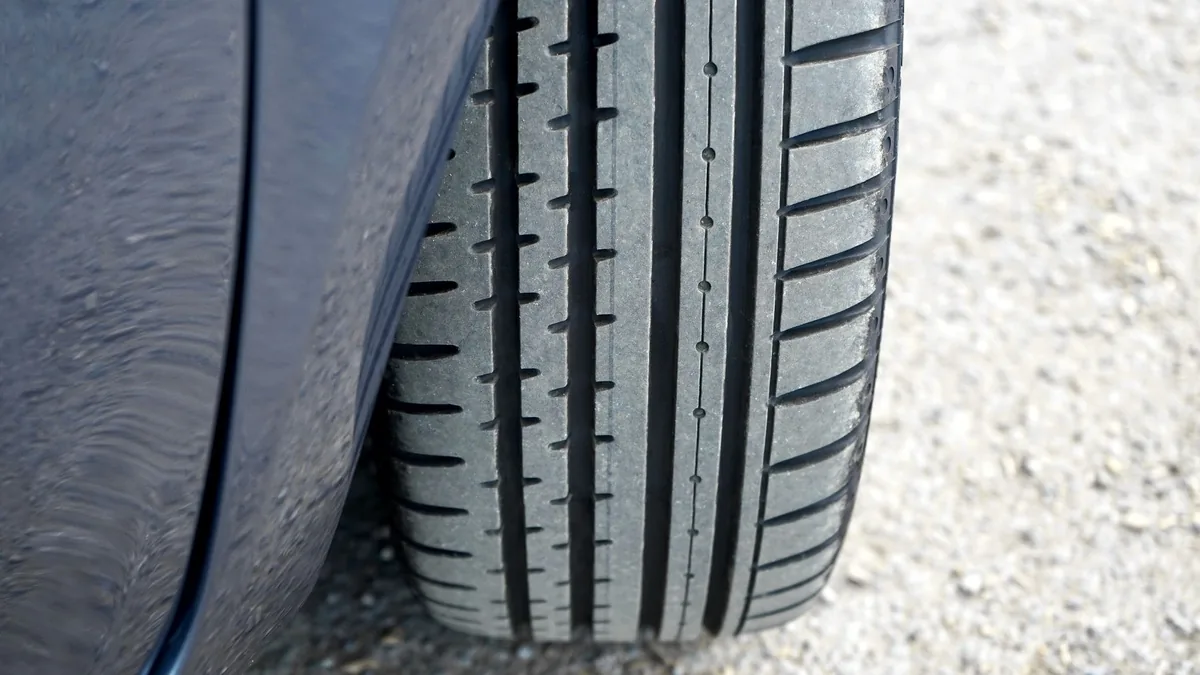
The tread wear indicator bars moulded into the grooves are set at 1.6 millimetres. When the tread surface is level with those bars, the tyre is at the legal limit and has no margin left. Most drivers replace well before that, and the reason is not the law: a tyre at 1.6 millimetres clears water far less effectively than one at four, and the gap in wet braking widens quickly as the tread disappears. That is also why the wet-grip letter on the label matters more than the noise figure.
How long a set lasts, and why we will not pretend to know
Here is where most tyre articles lose their nerve and invent a number. There is no official published average for how many kilometres a car tyre lasts, and the figures thrown around by retailers vary by a factor of three. It depends on the car's weight, the driven axle, the road surfaces, the driver's right foot, the alignment, the pressures and the compound. Rather than print a number we cannot verify, we are giving you the arithmetic and letting you put your own life figure in.
The method is simple. Take the price of a set of four, divide by the number of kilometres you expect the set to cover, and you have a cost per kilometre that you can compare with fuel. The table below does it for the cheapest set in each size at three different assumed lives, 30,000, 40,000 and 50,000 kilometres. Those are assumptions, not averages: they are there so you can see how much the answer moves when the assumption changes.
The shape of the answer is what matters. Over 40,000 kilometres, cheap tyres in a small size cost 4.90 pounds per 1,000 kilometres. In the biggest size, 7.84 pounds. If the set only lasts 30,000 kilometres instead, those figures become 6.53 and 10.46 pounds. The life assumption changes the cost per kilometre by a third, which is a bigger effect than the difference between a cheap set and a mid-range set in the same size.
| Size | Cheapest set of 4 | per 1,000 km at 30,000 km | at 40,000 km | at 50,000 km |
|---|---|---|---|---|
| 175/65 R14 | £183.96 | £6.13 | £4.60 | £3.68 |
| 185/65 R15 | £195.96 | £6.53 | £4.90 | £3.92 |
| 205/55 R16 | £199.96 | £6.67 | £5.00 | £4.00 |
| 225/45 R17 | £235.96 | £7.87 | £5.90 | £4.72 |
| 235/55 R18 | £313.68 | £10.46 | £7.84 | £6.27 |
| 245/40 R19 | £310.40 | £10.35 | £7.76 | £6.21 |
Tyre cost per year at 15,000 kilometres
Annualising it makes the number comparable with insurance, tax and fuel. At 15,000 kilometres a year and an assumed 40,000 kilometre set life, a car covers 0.375 sets a year. The table below applies that to the cheapest, median and dearest set in each size.
The cheapest-car answer is that tyres cost 68.98 pounds a year in the smallest size, and 74.98 pounds a year on a 205/55 R16 if you buy the cheapest set. On the same size, buying the median tyre takes it to 138.74 pounds, and the dearest listed tyre takes it to 163.49 pounds. So the entire budget decision on tyres, for a typical family car, sits inside a range of about 90 pounds a year. On a 245/40 R19 the same range runs from 116.40 pounds to 338.99 pounds a year, which is a difference of 222.59 pounds annually, every year, for as long as you own the car.
That is the honest way to think about tyre spending: it is a small annual line for most cars and a significant one for cars on large wheels. It is never the biggest running cost, and it is never nothing.
| Size | Cheapest set per year | Median set per year | Dearest set per year |
|---|---|---|---|
| 175/65 R14 | £68.98 | £97.48 | £158.99 |
| 185/65 R15 | £73.48 | £104.98 | £187.49 |
| 205/55 R16 | £74.98 | £138.74 | £163.49 |
| 215/55 R17 | £88.48 | £191.99 | £262.49 |
| 225/45 R17 | £88.48 | £147.74 | £182.99 |
| 235/55 R18 | £117.63 | £226.49 | £277.49 |
| 245/40 R19 | £116.40 | £261.74 | £338.99 |
Tyres versus fuel: where the money actually goes
Now put the tyre number next to the fuel number, because that is the comparison that decides whether tyre shopping deserves your attention. Our own database holds 823 current UK certification records, and the median certified petrol consumption in it is 7.7 litres per 100 kilometres. At the UK pump price of 1.64 pounds a litre, that is 126.28 pounds of petrol per 1,000 kilometres. The median diesel figure is 6.1 litres per 100 kilometres, which at 1.86 pounds a litre is 113.46 pounds per 1,000 kilometres.
Against that, the cheapest 205/55 R16 set costs 5.00 pounds per 1,000 kilometres at a 40,000 kilometre life. Tyres are about 4 per cent of what fuel and tyres cost together. Even the dearest tyre on our page, at 903.96 pounds for a set of four over 40,000 kilometres, works out at 22.60 pounds per 1,000 kilometres, still under a fifth of the fuel bill.
This is why the tyre decision is a safety and comfort decision far more than a financial one. Changing from a cheap set to a mid-range set on a family car costs about 60 pounds a year. Getting the tyre size wrong, or buying a car whose wheels are an inch bigger than they need to be, costs several times that. The money is in the size, not in the brand.
For electric cars the fuel side is different: the median certified consumption in our UK records is 16.9 kWh per 100 kilometres, which at household electricity prices is a far smaller per-kilometre figure than petrol. The tyre side does not shrink with it, so tyres are a larger share of an electric car's running cost than of a petrol car's.
What is included in a fitted price
The prices in this article are fitted prices: the figure shown on the listing includes standard fitting at one of the retailer's partner garages. That is the number to compare, because a mail-order tyre price without fitting is not a price you can act on. When you compare quotes, compare the fitted total for four tyres, at a garage you would actually use, and check whether the fitting includes a new valve and balancing.
Anything beyond standard fitting is priced separately and it is where the bill grows. Wheel alignment, a tyre guarantee or damage cover, disposal of the old tyres, nitrogen inflation and TPMS sensor replacement are all add-ons in most quotes. We are not publishing prices for them, because we could not verify them across enough sellers to be honest about a range: what we can tell you is that they exist, that they are quoted separately, and that you should ask for the fitted total including everything before you agree.
One more practical point. Tyre prices move with the season and with stock. Winter sizes tighten in October and November, and a size that is cheap in spring can be dear in autumn. The prices here are a single day, 24 October 2026, and they are most useful as a shape and a sanity check rather than as a quote.
Do you need four new tyres, or will two do?
The law does not require four tyres of the same brand, or even four tyres with the same tread depth. It requires every fitted tyre to meet the 1.6 millimetre rule and to be suitable for the wheel. So replacing a pair on one axle is legal, and it is what most people do when one axle wears first, which is common on front-wheel-drive cars where the driven wheels do the work.
The handling argument for pairs is about balance. Fit the new pair to the rear axle, not the front, because a rear tyre with less grip than the front is the combination that produces oversteer in the wet, and oversteer is much harder to correct than understeer. This is the opposite of what most drivers assume, and it is the standard recommendation from tyre manufacturers and road safety bodies.
Beyond pairs, the rule that matters is not to mix tyres of very different capability on the same axle. A D-rated cheap tyre on one side and a B-rated premium tyre on the other means the car brakes unevenly in the wet. If you are buying two, buy two of the same model. On a four-wheel-drive car, a large difference in tread depth between axles can also upset the drivetrain, so the safe habit is to keep all four close together in wear.
Wheel alignment: the cheap job that saves tyres
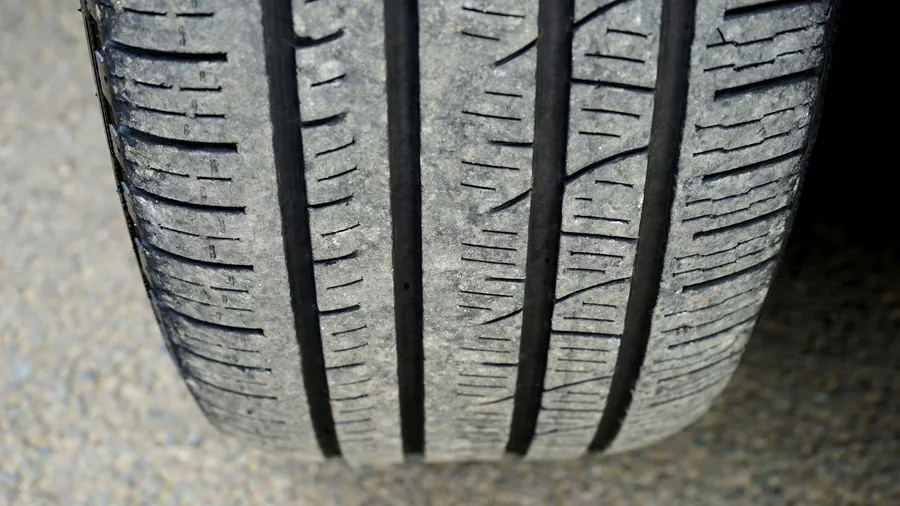
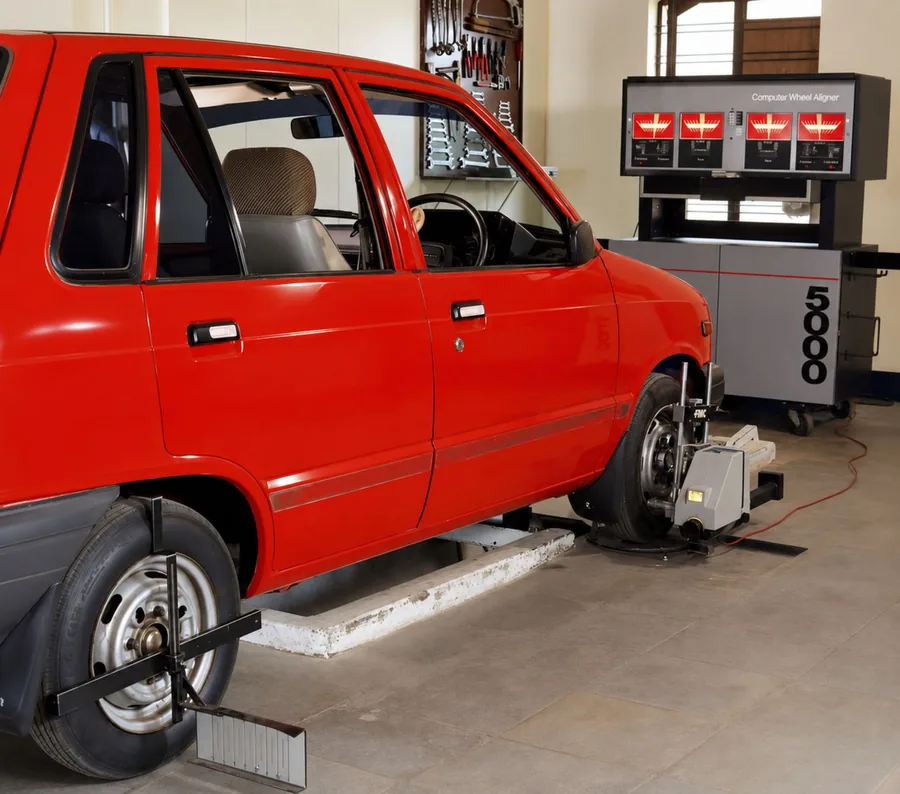
A set of tyres worn unevenly across the tread is money thrown away, and alignment is the usual cause. If the inside edge of a front tyre is bald while the outside still has tread, the wheel is not pointing where the car is going, and the tyre has been scrubbing sideways for thousands of kilometres. The tread is legal in one place and gone in another, which also means the 1.6 millimetre rule is failed at that edge even though the middle looks fine.
The tell-tales are simple to check without equipment. Run your hand across the tread of each tyre from inside to outside: it should feel smooth, not saw-toothed. Look at the wear pattern from above in good light. If one edge is visibly smoother than the other, or if the car pulls to one side on a straight flat road, get the alignment checked. Hitting a kerb or a deep pothole is enough to knock it out.
We are deliberately not printing an alignment price, because it varies too much between chains, independents and regions for us to stand behind a figure. What we can say is directional: relative to the cost of replacing a prematurely worn pair of tyres, an alignment check is a small amount of money, and it is the single most common way to make a set last its full life rather than two-thirds of it.
Where to buy tyres: fitted online versus the local garage
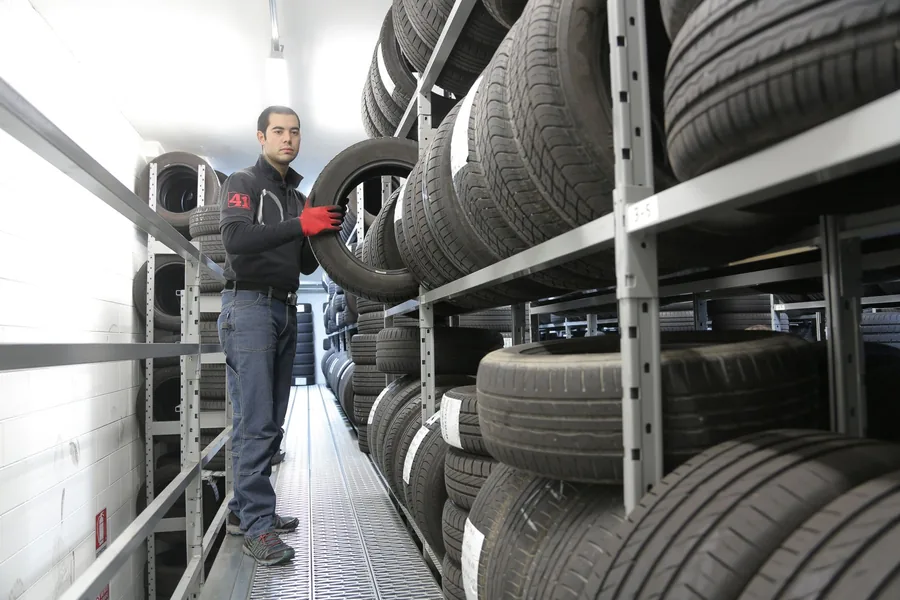
The prices in this article come from an online retailer with a partner fitting network, which is now the largest part of the UK market. You choose the tyre and the garage, the tyre is delivered there, and you pay one fitted price. The advantage is that you see the whole range, including budget brands a local garage may not stock, and you see the label ratings side by side before you commit.
The local independent has two advantages of its own. The first is availability today: a puncture or a damaged sidewall is not a price-comparison problem, it is a same-day problem, and a garage with the size on the shelf solves it. The second is that the person fitting the tyre is the person you will deal with if something is wrong, which matters more than a few pounds when a wheel is damaged during fitting.
The practical rule is to price it both ways for anything that is not urgent. Get the fitted online total for four tyres, then ring the garage you would use anyway and ask for the same size fitted. The gap is often smaller than expected once fitting, valves, balancing and disposal are included on both sides, and the local quote comes with a person attached.
Part-worn tyres: legal, cheap, and worth checking hard
Part-worn tyres are legal to sell in the UK, subject to conditions, and they are the cheapest way to keep an old car legal. They are also the category where the 1.6 millimetre rule does the most work, because a part-worn tyre is by definition closer to it than a new one.
If you are buying part-worn, the checks that matter are all visual and all quick. Measure the tread across the central three quarters, not at the edge. Look for cuts, bulges, or repairs in the sidewall, which are a walk-away. Check the four-digit date code on the sidewall: the first two digits are the week and the last two the year of manufacture, so 3219 means the 32nd week of 2019. Rubber ages even when it is not worn, and a tyre that has spent years in the sun is not a bargain at any price.
Our price data cannot help you here, and we are not going to invent a range for part-worn tyres: the condition varies so much that a single number would be meaningless. What the data does tell you is the new-price floor, which is what makes a part-worn decision rational or not. If a new tyre in your size is 48.99 pounds fitted, a part-worn at 30 pounds with half its tread gone is not a saving worth the risk.
Buying a used car: read the tyres before you read the service book
Tyres tell you more about how a car has been treated than almost anything else you can check in ten minutes. Four matching tyres of a decent brand suggest an owner who spent money on the car. Four different brands, three of them budget, suggest the opposite. A single nearly new tyre on one corner is often the trace of a kerbed wheel or a puncture that was repaired in a hurry.
Check the date codes across all four. If three tyres were made in the same year and one is four years newer, that corner has a story. Check the wear pattern on each, inside and outside edge, for the alignment tell-tales above. And check that the size on the car matches the size in the handbook or on the fuel flap sticker: a car sitting on the wrong size has been maintained by someone who did not check.
Then price the tyres into the deal. If the car you are looking at needs four tyres, the cost is in the table at the top of this page, and it is a legitimate negotiating point with a real number behind it. A car needing a 245/40 R19 set is 310.40 pounds away from legal at the cheapest end and 903.96 pounds at the dearest, before you have driven it a mile.
Our car comparison and ownership cost tools let you put two cars' full running costs side by side, including the fuel side we computed above from certified consumption data.
Why tyre prices vary so much inside one size
The spread inside a size is bigger than the spread between sizes at the cheap end, and it is worth understanding before you assume the dearest tyre is the best one. In 215/55 R17 the per-tyre price ran from 58.99 to 174.99 pounds, a factor of 3.0. In 245/40 R19 it ran from 77.60 to 225.99 pounds, a factor of 2.9. In 235/55 R18 it ran from 78.42 to 184.99 pounds, a factor of 2.4.
Part of that is genuine capability, and the label shows it: the 78.42 pound Accelera in 235/55 R18 is rated C for wet grip while the 184.99 pound Michelin CrossClimate 2 in the same size is rated A. Part of it is brand, and part of it is the segment the tyre is built for: an all-season tyre with a three-peak mountain snowflake marking, a run-flat, or an SUV-specific carcass all cost more to make than a plain summer tyre in the same size.
The way to read the spread is to decide which of those you actually need. If you drive in snow, an all-season tyre may be the right buy and the premium is justified. If you do not, paying a premium for an all-season compound you will never use is a waste, and the label will often show a plain summer tyre at half the price with the same wet rating.
What we could not verify, and why that matters
We tried to price tyres in Ireland, Germany, France and other European markets for this article and could not do it honestly. The retailers with machine-readable price listings in those markets blocked automated price checks on the day we tried: two large European online tyre retailers returned an access error, one returned a page with no prices in it, and the Irish retailers either blocked the request or returned no usable price data. We could have invented a plausible euro figure. We are not going to.
So this page prices the UK market, where we could read 240 real listings on one day with the label ratings attached, and it says so throughout. The other markets' prices are not simply the UK figures converted: VAT rates differ, fitting charges differ, and the brand mix on sale differs. A converted UK figure would look like a fact and be a guess.
Two other things are absent by choice. There is no average tyre lifespan figure, because no official body publishes one and the retail figures vary by a factor of three; the cost per kilometre tables use stated assumptions you can change. And there are no alignment, fitting or disposal prices, because they are quoted per garage and we could not verify a range across enough sellers. Where a number is missing here, it is missing on purpose.
What to do before you buy tyres this week
The order of operations matters more than the shopping, because most of the money is decided before you look at a single price. Work through this list and the buying becomes a five-minute job.
- Read the size off the sidewall of a tyre on your car, or from the sticker inside the fuel flap. Write it down exactly, including the load index and speed rating after the size.
- Measure the tread on all four tyres across the central three quarters, not at the edge. Anything at or near 1.6 millimetres is an immediate replacement.
- Check the four-digit date code on each tyre. Anything over about six years old should be replaced on age grounds even with tread left.
- Look for uneven wear across each tread. If one edge is smoother, budget for an alignment check at the same time as the tyres.
- Price the exact size fitted, in the cheapest, median and best-label versions, using the tables above as your sanity check on what that size should cost.
- Compare the online fitted total against a local garage quote for the same size, all in, including valves, balancing and disposal.
- Check the label on the exact listing you are buying, not on the model name, because the same model can be built to two different specifications.
Use the free calculators
Frequently asked questions
How much does it cost to replace all four tyres?
On 24 October 2026 a set of four fitted tyres cost from 183.96 pounds in 175/65 R14 to 310.40 pounds in 245/40 R19 at the cheapest end, and from 259.96 to 697.96 pounds at the median. The dearest set we found in the largest size was 903.96 pounds. The size on your car decides which of those applies, so check the sidewall before you budget.
Are cheap tyres any good?
They are legal and in some sizes sensible, but the saving usually comes out of wet grip. Twelve of the 30 cheapest tyres we priced carried a D or E wet-grip rating, the lowest classes on the EU label. They are not automatically bad on rolling resistance: the cheapest tyre in 245/40 R19 was rated A for rolling resistance. Judge the label, not the price.
How much is a 205/55 R16 tyre?
In 205/55 R16, the most common European size, per-tyre fitted prices ran from 49.99 to 108.99 pounds on 24 October 2026, with a median of 92.49 pounds. A set of four therefore runs from 199.96 to 435.96 pounds, or 369.96 pounds for four median tyres. The cheapest in that size carried a D wet-grip rating.
How long do tyres last?
There is no official published average, and retail figures vary by a factor of three, so any single number is a guess. What we can do is the arithmetic: a set costing 199.96 pounds over 40,000 kilometres is 5.00 pounds per 1,000 kilometres, and over 30,000 kilometres it is 6.67 pounds. Use your own expected mileage rather than someone else's average.
What is the legal tyre tread depth in the UK?
1.6 millimetres. Under regulation 27 of the Motor Vehicles (Construction and Use) Regulations 1986 it must be at least that deep across a continuous band covering the central three-quarters of the tread width, all the way round the circumference. The wear bars in the grooves are set at that depth, so a tyre level with them has no margin left. Ireland checks tyre tread at the NCT too, under its own rules.
Is it cheaper to buy tyres online and have them fitted?
Usually, because you see the whole range including budget brands a local garage may not stock, and the fitted price is shown up front. The gap narrows once fitting, valves, balancing and old-tyre disposal are included on both sides. For anything not urgent, get the online fitted total and a local all-in quote for the same size before deciding.
Do I need wheel alignment when I buy new tyres?
Not automatically, but check the old tyres before you decide. If the wear is uneven across the tread, with one edge smoother than the other, or the car pulls to one side, the alignment is out and new tyres will wear the same way. Replacing tyres without fixing alignment is the most common way to waste two-thirds of a set's life.