Cheapest cars to run in Ireland: your 2026 running-cost breakdown

The cheque you write at the dealership is the smallest number in the deal. What decides whether a car is cheap or expensive in Ireland is the annual stack of energy, motor tax, insurance, NCT and depreciation — the money that leaves your account every month for as long as you keep the keys.
For this 2026 update we ranked every Irish-market model in the official type-approval data by what it costs to move, using verified Irish prices. The result is a straight efficiency index: consumption per 100 km converted into euros a year at 15,000 km.
How the 2026 Ireland cheapest-to-run ranking was built
Official type-approval records for the Irish market sit in three VCA datasets in our vehicle database: vca-uk, vca-mega and vca-archive, holding 17,270 rows between them. Filtering to models with a usable consumption figure, then removing implausible records and duplicate model-year variants, leaves 16,728 rows and 7,322 distinct make, model and powertrain combinations — 3,855 petrol, 2,966 diesel, 341 hybrid and 160 electric.
Annual cost comes straight from the certified figure: litres per 100 km, divided by 100, times 15,000 km, times the pump price. Electric cars use kWh per 100 km at the household rate. The constants are the verified Irish defaults used across our calculators: petrol €1.84 per litre, diesel €1.92, household electricity €0.38 per kWh, 15,000 km a year, NCT €55 every two years, and a motor tax reference of about €210 a year for the 111–120 g/km CO₂ band.
Every euro figure in this guide is energy cost only: consumption per 100 km x 15,000 km x the Irish unit price. Motor tax and NCT are quoted separately for context and are never added into the table totals.
Data quality disclosure: every row we removed, and why
From 17,270 rows we excluded 542. Three petrol or diesel records carried consumption outside the plausible 2.5 to 25.0 L/100km window used across the site. No electric record fell outside the 5.0 to 40.0 kWh/100km window. Two rows tagged as ordinary hybrids recorded under 3.0 L/100km — a plug-in test artefact — and were dropped from the hybrid table and averages.
The other 537 are plug-in hybrids: 408 with a consumption figure and 129 without. Their official numbers are not one consistent driving mode, because the test assumes a fully charged battery for part of every trip. We publish no PHEV leaderboard rather than a figure you cannot reproduce on a wet Tuesday in February.
Average running cost by fuel type in Ireland
Across the 7,322 model entries, the average petrol car consumes 8.4 L/100km and emits 196 g/km CO₂ — €2,315 a year in fuel at €1.84 per litre over 15,000 km. The average diesel is far more frugal on paper at 5.7 L/100km and 150 g/km, or €1,641 a year. The average non-plug hybrid sits at 6.1 L/100km and 139 g/km, or €1,696, and the average electric car uses 17.4 kWh/100km, or €992 a year.
Two things stand out. The electric average undercuts the diesel average even though the EV pool is full of large, heavy cars. And the hybrid average is higher than diesel, which surprises people who assume hybrid always means lowest fuel use: the hybrid pool is dominated by big SUVs and premium saloons, while the diesel pool is mostly small hatchbacks.
| Powertrain | Models | Average consumption | Average CO₂ | Average annual energy cost |
|---|---|---|---|---|
| Petrol | 3,855 | 8.4 L/100km | 196 g/km | €2,315 |
| Diesel | 2,966 | 5.7 L/100km | 150 g/km | €1,641 |
| Hybrid (non-plug) | 341 | 6.1 L/100km | 139 g/km | €1,696 |
| Electric | 160 | 17.4 kWh/100km | not recorded in source | €992 |
Cheapest petrol cars to run in Ireland
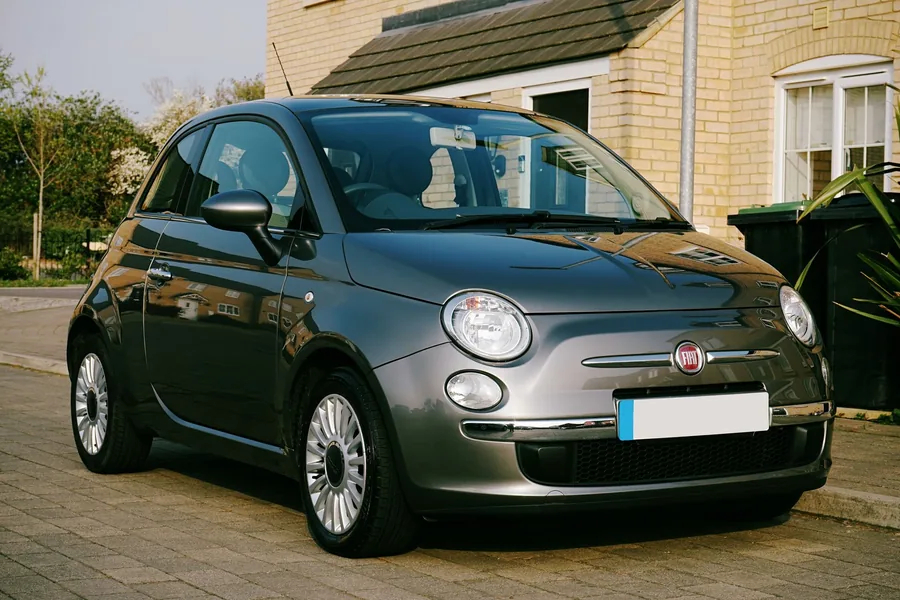
The petrol table is led by the Honda Insight at 3.4 L/100km and €938 a year — an early two-seat design type-approved as a petrol car. Behind it sits a tight cluster: the Suzuki Celerio at 3.6 L/100km and €994, then the Citroën C1, Peugeot 108, Fiat 500 and 500C and the petrol-tagged Kia Niro at 3.8 L/100km and €1,049. A fourth group at 4.0 L/100km and €1,104 adds the Hyundai i10, Peugeot 308 and Smart fortwo coupé.
The spread inside the table is under €200 a year between the best and the tenth-placed car. Against the average it is enormous: the cheapest petrol car costs €938 to move, the average petrol car €2,315. Choosing from the top of this list instead of the middle of the market is worth about €1,380 a year, every year.
| Make | Model | Year | Consumption | CO₂ | Annual energy cost |
|---|---|---|---|---|---|
| Honda | Insight | 2003 | 3.4 L/100km | 80 g/km | €938 |
| Suzuki | Celerio | 2017 | 3.6 L/100km | 84 g/km | €994 |
| Citroën | C1 | 2016 | 3.8 L/100km | 88 g/km | €1,049 |
| Peugeot | 108 | 2014 | 3.8 L/100km | 88 g/km | €1,049 |
| Fiat | 500 & 500C | 2018 | 3.8 L/100km | 90 g/km | €1,049 |
| Kia | Niro | 2018 | 3.8 L/100km | 88 g/km | €1,049 |
| Hyundai | i10 | 2017 | 4.0 L/100km | 93 g/km | €1,104 |
| Peugeot | 308 | 2017 | 4.0 L/100km | 95 g/km | €1,104 |
| Smart | fortwo coupé | 2016 | 4.0 L/100km | 98 g/km | €1,104 |
| Chrysler | Ypsilon | 2012 | 4.1 L/100km | 97 g/km | €1,132 |
Why the cheapest petrol cars are all small city cars
There is no trick: every car near the top is small, light and aerodynamically ordinary. Mass dominates urban and mixed driving, frontal area dominates at motorway speed, so the lightest bodies with the smallest footprints win. The first larger petrol car does not appear until consumption passes 5 L/100km.
The cost of that efficiency is space and pace. Cars at 3.6 to 4.1 L/100km are four-seaters with modest boots that feel strained fully loaded on the M50. Need five adults and luggage? You will land nearer 5 to 6 L/100km — still below average, but out of cheapest-to-run territory.
Cheapest diesel cars to run in Ireland
Diesel's advantage has narrowed in 2026 but has not vanished. The Peugeot 208 at 3.0 L/100km and €864 a year is the cheapest combustion car in this dataset, ahead of the Peugeot 308 at 3.1 L/100km and €893. From there the table flattens hard: the Citroën C4 Cactus, Kia Rio, Renault Clio, Volkswagen Golf, Škoda Octavia, Hyundai i20 and Nissan Micra all land at 3.2 L/100km and €922.
That flatness matters. Between third and fourteenth place there is not a euro of difference in annual energy cost, so the choice between those cars should turn on insurance group, NCT history and condition. Diesel still earns its keep on high-mileage open-road driving; below roughly 12,000 km a year the gap stops being a reason to buy one.
| Make | Model | Year | Consumption | CO₂ | Annual energy cost |
|---|---|---|---|---|---|
| Peugeot | 208 | 2017 | 3.0 L/100km | 79 g/km | €864 |
| Peugeot | 308 | 2017 | 3.1 L/100km | 82 g/km | €893 |
| Citroën | C4 Cactus | 2014 | 3.2 L/100km | 82 g/km | €922 |
| Hyundai | i20 | 2016 | 3.2 L/100km | 84 g/km | €922 |
| Kia | Rio | 2013 | 3.2 L/100km | 85 g/km | €922 |
| Nissan | Micra | 2017 | 3.2 L/100km | 85 g/km | €922 |
| Renault | Clio | 2014 | 3.2 L/100km | 83 g/km | €922 |
| Škoda | Octavia | 2014 | 3.2 L/100km | 85 g/km | €922 |
| Volkswagen | Golf | 2014 | 3.2 L/100km | 85 g/km | €922 |
Why diesel no longer wins outright in Ireland
Diesel costs €1.92 a litre against €1.84 for petrol — a premium of just over four per cent — so a diesel car has to be measurably more efficient than a petrol alternative to break even. Modern small petrol turbos have closed most of that gap. The Peugeot 208 diesel costs €864 a year; the cheapest petrol car costs €938. The entire annual prize for choosing diesel over the best petrol on the market is about €74.
Set that against higher list prices, costlier servicing and the risk profile around particulate filters and short trips. A diesel doing five-kilometre school runs can lose more in DPF repairs than it ever saves at the pump. For genuine motorway mileage it still works; for everyone else in 2026 it is cost-neutral at best.
What a tank of fuel actually costs in Ireland
Unit prices are abstract; a full tank is not. At €1.84 a litre a 50-litre tank of petrol costs about €92. The same tank of diesel at €1.92 costs about €96. If that tank carries you 700 km, your fuel cost per kilometre is around 13 cent; at 400 km it is around 23 cent. Multiply the second figure by 15,000 km and you are looking at the difference between a €1,950 fuel year and a €3,450 one.
This is why consumption matters more than the pump price. Pump prices move by a few cent and everyone pays roughly the same; consumption varies five-fold between cars in the same showroom — and you control that at the point of purchase. The tables above show which models give you the best version of it.
Cheapest non-plug hybrids to run in Ireland
Strip out plug-in hybrids and the conventional hybrid table is a Toyota procession. The Prius at 3.0 L/100km and €828 a year is the cheapest non-electric car in the dataset — cheaper to run than the best diesel and the best petrol alike. The Yaris and Yaris Hybrid follow at 3.3 L/100km and €911, the Hyundai Ioniq and later Prius at 3.4 L/100km and €938, and the Auris, Auris Touring Sports, Lexus CT and CT200h cluster at 3.5 to 3.6 L/100km between €966 and €994.
Hybrids combine city-car efficiency with mid-size practicality: a Prius or Auris carries a family, cruises at 120 km/h and still returns a certified figure in the low threes. The best numbers belong to Toyota's own architecture — a non-Toyota hybrid typically sits at 3.7 to 4.0 L/100km, excellent but no longer table-topping.
| Make | Model | Year | Consumption | CO₂ | Annual energy cost |
|---|---|---|---|---|---|
| Toyota | Prius | 2018 | 3.0 L/100km | 70 g/km | €828 |
| Toyota | Yaris Hybrid | 2018 | 3.3 L/100km | 75 g/km | €911 |
| Hyundai | IONIQ | 2017 | 3.4 L/100km | 79 g/km | €938 |
| Toyota | Auris | 2018 | 3.5 L/100km | 79 g/km | €966 |
| Toyota | Auris Touring Sports | 2018 | 3.5 L/100km | 81 g/km | €966 |
| Lexus | CT | 2014 | 3.6 L/100km | 82 g/km | €994 |
| Lexus | CT200h | 2018 | 3.6 L/100km | 82 g/km | €994 |
| Kia | Niro | 2018 | 3.7 L/100km | 86 g/km | €1,021 |
| Toyota | C-HR | 2018 | 3.8 L/100km | 86 g/km | €1,049 |
| Mazda | Mazda2 Hybrid | 2026 | 3.8 L/100km | 87 g/km | €1,049 |
Cheapest electric cars to run in Ireland
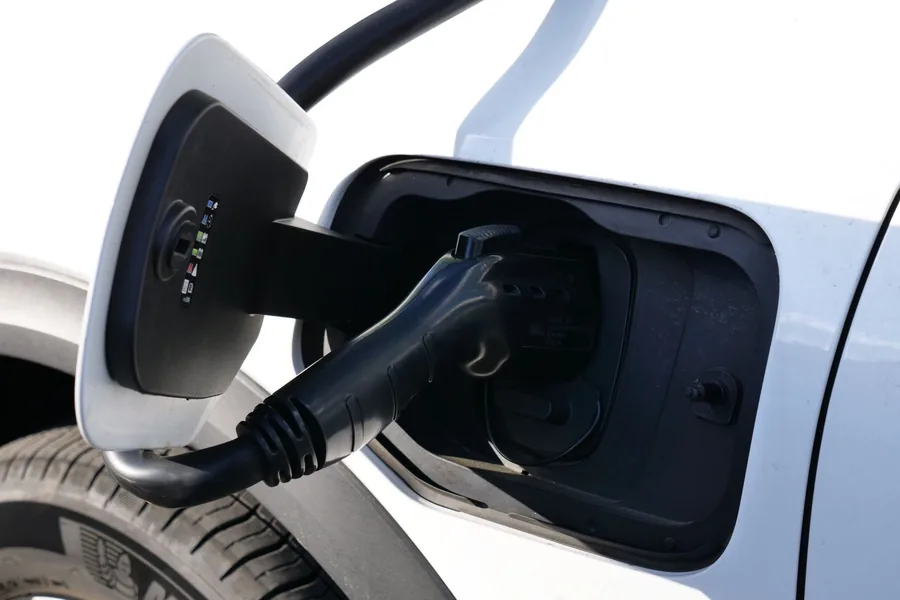
Electric wins this contest outright. The Mini Aceman at 10.9 kWh/100km costs €621 a year at the household rate — about €200 less than the best car of any other powertrain and under a third of the average petrol car's fuel bill. The Mercedes-Benz CLA Saloon follows at 12.2 kWh/100km and €695, the Dacia Spring at 12.5 kWh/100km and €712, the Fiat 500 at 13.3 kWh/100km and €758, and the Tesla Model 3 at 13.8 kWh/100km and €787 — still below the cheapest petrol car in the entire dataset.
The table is unusually compressed: under €200 a year separates the best electric car from the tenth-placed one, so you do not need to hunt for the most efficient EV in Ireland. The differences that matter between electric models are purchase price, range, charging speed and how much charging you can do at home.
| Make | Model | Year | Consumption | CO₂ | Annual energy cost |
|---|---|---|---|---|---|
| Mini | MINI Aceman | 2026 | 10.9 kWh/100km | not recorded | €621 |
| Mercedes-Benz | CLA Saloon | 2026 | 12.2 kWh/100km | not recorded | €695 |
| Dacia | Spring | 2026 | 12.5 kWh/100km | not recorded | €712 |
| Fiat | 500 | 2025 | 13.3 kWh/100km | not recorded | €758 |
| Tesla | Model 3 | 2026 | 13.8 kWh/100km | not recorded | €787 |
| Peugeot | 2008 | 2026 | 14.2 kWh/100km | not recorded | €809 |
| Tesla | Model Y | 2026 | 14.2 kWh/100km | not recorded | €809 |
| Volkswagen | ID.7 | 2026 | 14.2 kWh/100km | not recorded | €809 |
| Hyundai | KONA ELECTRIC | 2023 | 14.3 kWh/100km | not recorded | €815 |
| Lexus | RZ 350e | 2026 | 14.7 kWh/100km | not recorded | €838 |
What 15,000 km of electricity costs an Irish EV driver
These figures assume every kilometre is charged at home on a €0.38 per kWh tariff, and that assumption deserves stating, because Irish household electricity is the most expensive in the EU: recent Eurostat comparison puts the EU average near €0.22 per kWh against an Irish figure above €0.40. Even so the arithmetic favours electricity — 14 kWh/100km costs about €800 a year for 15,000 km, while a petrol car at 6 L/100km costs about €1,656.
The comparison changes if you cannot charge at home. Public rapid charging in Ireland is priced per kWh at substantially higher rates, and a driver relying on it entirely can pay more per kilometre than a small petrol car. Home charging is not a convenience in this calculation; it is the assumption that makes the electric case work. No driveway, no €621 year.
The overall cheapest cars to run in Ireland: top 17
Putting every powertrain into one ranking produces a result that is hard to argue with. The top 17 distinct models by annual energy cost are all electric except one: the Toyota Prius hybrid, twelfth at 3.0 L/100km and €828, and the only car in the list that burns fuel. Everything above and below it runs on electricity, from the Mini Aceman at €621 to a four-way tie of midsize EVs at 14.8 kWh/100km and €844.
The convergence is striking. The best electric car costs €621 a year and the seventeenth-best €844 — a €223 spread. In the petrol table the equivalent spread runs to thousands. Electric cars have compressed running cost into a narrow band, so choose between them on price, size and charging, not efficiency. The Prius is the exception that matters for drivers who cannot charge at home.
| Rank | Make | Model | Year | Powertrain | Consumption | Annual energy cost |
|---|---|---|---|---|---|---|
| 1 | Mini | MINI Aceman | 2026 | Electric | 10.9 kWh/100km | €621 |
| 2 | Mercedes-Benz | CLA Saloon | 2026 | Electric | 12.2 kWh/100km | €695 |
| 3 | Dacia | Spring | 2026 | Electric | 12.5 kWh/100km | €712 |
| 4 | Fiat | 500 | 2025 | Electric | 13.3 kWh/100km | €758 |
| 5 | Tesla | Model 3 | 2026 | Electric | 13.8 kWh/100km | €787 |
| 6 | Peugeot | 2008 | 2026 | Electric | 14.2 kWh/100km | €809 |
| 7 | Tesla | Model Y | 2026 | Electric | 14.2 kWh/100km | €809 |
| 8 | Volkswagen | ID.7 | 2026 | Electric | 14.2 kWh/100km | €809 |
| 9 | Mini | MINI Cooper Electric | 2026 | Electric | 14.2 kWh/100km | €809 |
| 10 | Hyundai | KONA ELECTRIC | 2023 | Electric | 14.3 kWh/100km | €815 |
| 11 | Volkswagen | ID.7 Tourer | 2026 | Electric | 14.6 kWh/100km | €832 |
| 12 | Toyota | Prius | 2018 | Hybrid | 3.0 L/100km | €828 |
| 13 | Lexus | RZ 350e | 2026 | Electric | 14.7 kWh/100km | €838 |
| 14 | Lexus | ES 350e | 2026 | Electric | 14.8 kWh/100km | €844 |
| 15 | Mini | MINI Countryman | 2026 | Electric | 14.8 kWh/100km | €844 |
| 16 | Toyota | C-HR+ | 2026 | Electric | 14.8 kWh/100km | €844 |
| 17 | Vauxhall | Frontera | 2026 | Electric | 14.8 kWh/100km | €844 |
What the ranking does not include
Everything above is energy cost — the most predictable part of running a car and the easiest to compare, but not the biggest part for most owners. Insurance varies most between drivers: two people can quote the same model and see premiums several hundred euro apart on age, history, address and claims record alone. Tyres follow size, weight and driving style, and an EV's instant torque and extra mass tend to shorten their life. Servicing differs by powertrain: an electric car has no oil, filters or exhaust, but still needs brake fluid, cabin filters and inspections.
Then there is depreciation, which for new-car buyers dwarfs everything else. A typical new car loses 15 to 25 per cent of its value in year one and roughly half over five years. A €40,000 car can shed €20,000 of value, while five years of fuel for the average petrol car costs about €11,575. A ranking of €621 against €938 fills one line of that ledger.
The ranking excludes insurance, tyres, servicing, repairs, depreciation, motor tax, NCT fees and public charging prices. Two cars a few euro apart here can differ by thousands a year once those are added.
Motor tax in Ireland: the CO₂ bands and the €210 reference
Irish motor tax is charged on the car's official CO₂ emissions, and for cars registered after July 2008 the band is fixed for the life of the vehicle. Our reference rate is about €210 a year for the 111–120 g/km band; lower bands pay less, higher bands pay progressively more. That is a second reason the models at the top of these tables are cheap to own as well as cheap to drive: nearly every car in the petrol, hybrid and diesel leaderboards sits below 100 g/km.
Check the CO₂ figure before you buy, not after. Two cars with similar list prices can sit several bands apart, and the difference follows you as long as you own the car. Confirm the current rate on the official motor tax table for your model.
NCT costs and the risk of a failed test
The National Car Test costs €55 and is required every two years once a car is over four years old — roughly €28 a year averaged across the ownership period. Next to depreciation that is trivial, but the test is not only a fee: it turns an unplanned fault into an unplanned bill, since brakes, suspension, lighting and emissions are all examined and a failed car must be repaired and re-presented.
For used-car buyers the NCT history is one of the most useful documents available: it records the date and outcome of previous tests and the mileage at each one. A clean two-yearly record with steady mileage is a far safer purchase than gaps, retests or an unexplained mileage drop. Treat a missing record as a reason to walk away, not to haggle.
Worked example: turning these figures into your own annual cost
Take a 2018 Toyota Yaris Hybrid at 3.3 L/100km. At €1.84 a litre and 15,000 km it costs €911 in petrol. Add motor tax at the €210 reference and NCT at €27.50 a year averaged, and you are at €1,148.50 of predictable cost before insurance and servicing. Now take a 2026 Tesla Model 3 at 13.8 kWh/100km charged at home on €0.38 electricity: €787 of energy and the same €27.50 NCT allowance. The comparison turns on charging access, not on fuel.
Scaling is the point. Halve your mileage and every fuel figure halves; double it and a diesel or an EV looks considerably better than it did at 15,000 km, because their advantage compounds with distance. Under about 8,000 km a year the energy tables matter far less than fixed costs, and the right answer is usually the cheapest car to insure and maintain rather than the most efficient one.
How to use this ranking before you buy
These tables are a starting point, not a verdict. They show which cars convert energy into distance most efficiently at verified Irish prices, and that the gap between the best and the average is worth over a thousand euro a year. They do not know your mileage, tariff or insurance profile. Work through the steps in order for a defensible shortlist.
- Shortlist three to five models from the tables by the powertrain that fits your mileage and charging access.
- Get real insurance quotes on each one — the single largest variable for most drivers.
- Check the CO₂ figure for each model so you know the motor tax band before you commit.
- Scale the energy figures to your own annual mileage instead of the 15,000 km default.
- Price a set of tyres and a basic service for each model so the running costs are realistic.
- Model depreciation over your intended ownership period — it usually outweighs everything else.
The limits of official consumption figures
Every figure here is a certified type-approval result, produced on a laboratory cycle with controlled temperature, no passengers, no air conditioning and no headwind. Real Irish driving involves hills, traffic, weather, roof bars and full boots, so real consumption is higher than the certified number for almost every driver — but it applies to all cars roughly equally.
Treat the tables as an index of relative efficiency, not a promise of a weekly bill: the ranking order is robust, the euro figures are each car's best case. For a figure closer to your own reality, take the certified consumption and multiply it by your own prices and mileage.
Which powertrain should you choose in Ireland?
There is no single cheapest car to run in Ireland, because the answer depends on where the car is parked overnight and how far it travels. The data supports a simple decision tree. If you can charge at home and cover typical or high mileage, an electric car is the cheapest thing on four wheels by a wide margin, and the whole electric table beats the whole petrol table. If you cannot charge at home, a non-plug hybrid is the most efficient option that does not need a driveway — which is exactly why the Prius, Yaris and Auris top the non-electric data.
If you drive high motorway mileage and want the lowest energy cost without charging, a small diesel stays competitive, though its advantage over the best petrol is now about €74 a year. For low-mileage urban drivers the petrol city cars at 3.4 to 4.1 L/100km are the least risky choice: cheap to insure, easy to park and easy to resell.
Use the free calculators
Frequently asked questions
What is the single cheapest car to run in Ireland in 2026?
On official type-approval data at Irish prices, the 2026 Mini Aceman electric is cheapest at 10.9 kWh/100km — about €621 a year in household electricity over 15,000 km. The cheapest car that burns fuel is the 2018 Toyota Prius hybrid at 3.0 L/100km and €828 a year in petrol.
How much does the average Irish petrol car cost in fuel per year?
The petrol average across 3,855 model entries is 8.4 L/100km and 196 g/km CO₂. At €1.84 a litre over 15,000 km that is €2,315 a year. The cheapest petrol car in the same data costs €938, so choosing carefully is worth about €1,380 a year.
Is diesel still cheaper to run than petrol in Ireland?
Barely. Diesel costs €1.92 a litre against €1.84 for petrol, so the efficiency gain must cover a price premium. The cheapest diesel (Peugeot 208 at €864 a year) beats the cheapest petrol at €938 by about €74 annually. High open-road mileage improves the diesel case; short urban trips do not.
Are electric cars cheaper to run than petrol cars in Ireland?
On energy cost, yes. The cheapest EV costs €621 a year and every model in the electric top ten comes in under €844, while the cheapest petrol car costs €938. The catch is charging: these figures assume home charging at €0.38 per kWh, and public rapid charging costs far more.
Why are plug-in hybrids left out of the hybrid leaderboard?
Because their official figures assume a fully charged battery for part of every trip, producing consumption of 1 to 2 L/100km that few drivers reproduce. We excluded 537 plug-in hybrid rows — 408 with a consumption figure and 129 without — rather than publish a number that does not represent one consistent driving mode.
Do these annual costs include insurance, tyres, servicing and depreciation?
No. Every euro figure is energy cost only, calculated from certified consumption at €1.84 per litre petrol, €1.92 per litre diesel or €0.38 per kWh electricity over 15,000 km. Insurance, tyres, servicing, depreciation, motor tax and NCT are separate, and on a new car depreciation alone usually outweighs the fuel bill.